Year 10 (ages 14–15, Grade 9 in the US) · Religious education · GCSE Religious Studies · Lesson 7
The problem of evil and suffering
Moral and natural evil, why evil and suffering challenge belief in an omnipotent, omniscient and benevolent God (the inconsistent triad), and how this can lead some people to doubt or reject God.
Exam boards: this lesson matches the AQA and Pearson Edexcel GCSE religious education courses. Check which course your school follows.
8-minute video lesson
Teaching, worked examples and 20 practice questions solved step by step.
Watch free for a monthWhat your child will learn
- Distinguish moral and natural evil
- Explain the inconsistent triad
- Explain why evil challenges faith
- Give examples of each type of evil
The method
- Moral evil: caused by humans (e.g. war, theft).
- Natural evil: caused by nature (e.g. earthquakes, disease).
- Triad: an all-powerful, all-knowing, all-loving God… yet evil exists.
- Result: some doubt God; believers offer responses (next lesson).
Key words: moral evil, natural evil, omnipotent, omniscient, benevolent.
Worked examples
Worked examples from the lesson, with every step.
Question 1
Is a flood an example of moral or natural evil?
- Step 1: Caused by nature, not people.
- Step 2: Natural evil.
Answer: natural evil
Question 2
Is bullying an example of moral or natural evil?
- Step 1: Caused by a human choice.
- Step 2: Moral evil.
Answer: moral evil
Question 3
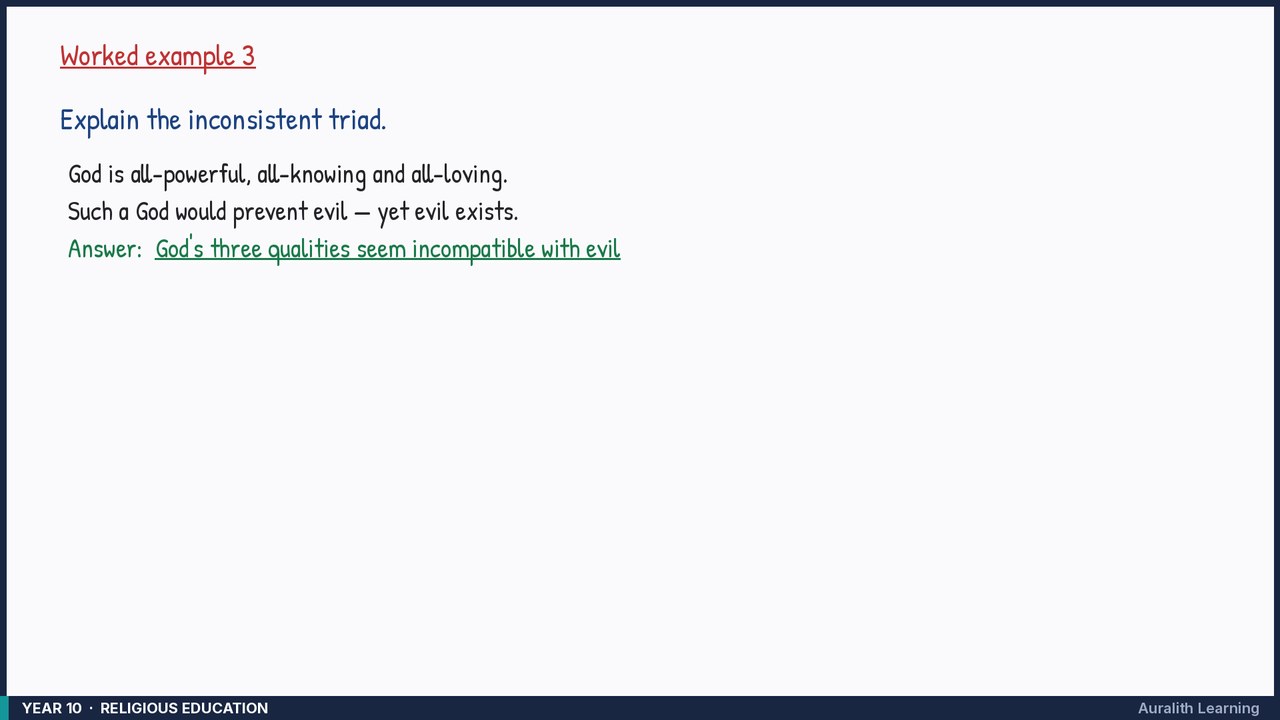
Explain the inconsistent triad.
- Step 1: God is all-powerful, all-knowing and all-loving.
- Step 2: Such a God would prevent evil — yet evil exists.
Answer: God's three qualities seem incompatible with evil