Year 10 (ages 14–15, Grade 9 in the US) · Religious education · GCSE Religious Studies · Lesson 26
Muslim practices: Sawm (fasting in Ramadan)
Sawm, fasting during the month of Ramadan: what the fast involves, who is excused, suhur and iftar, the Night of Power, and the spiritual and social benefits and challenges of fasting.
Exam boards: this lesson matches the AQA and Pearson Edexcel GCSE religious education courses. Check which course your school follows.
8-minute video lesson
Teaching, worked examples and 20 practice questions solved step by step.
Watch free for a monthWhat your child will learn
- Describe what Sawm involves
- Explain who is excused from fasting
- Explain the Night of Power
- Explain the benefits and challenges of Sawm
The method
- Ramadan: ninth month of the Islamic (lunar) calendar.
- Fast from dawn to sunset: no food or drink.
- Excused: young children, the ill, the elderly, pregnant or breastfeeding women, travellers.
- Benefits: self-control, empathy for the poor, closeness to Allah.
Key words: Sawm, Ramadan, suhur, iftar, Night of Power.
Worked examples
Worked examples from the lesson, with every step.
Question 1
Describe what Muslims do during Sawm.
- Step 1: During Ramadan, dawn to sunset.
- Step 2: No food or drink; avoid bad actions.
Answer: fast from dawn to sunset in Ramadan
Question 2
Give two groups who are excused from fasting.
- Step 1: The ill.
- Step 2: Young children.
Answer: e.g. the ill; young children
Question 3
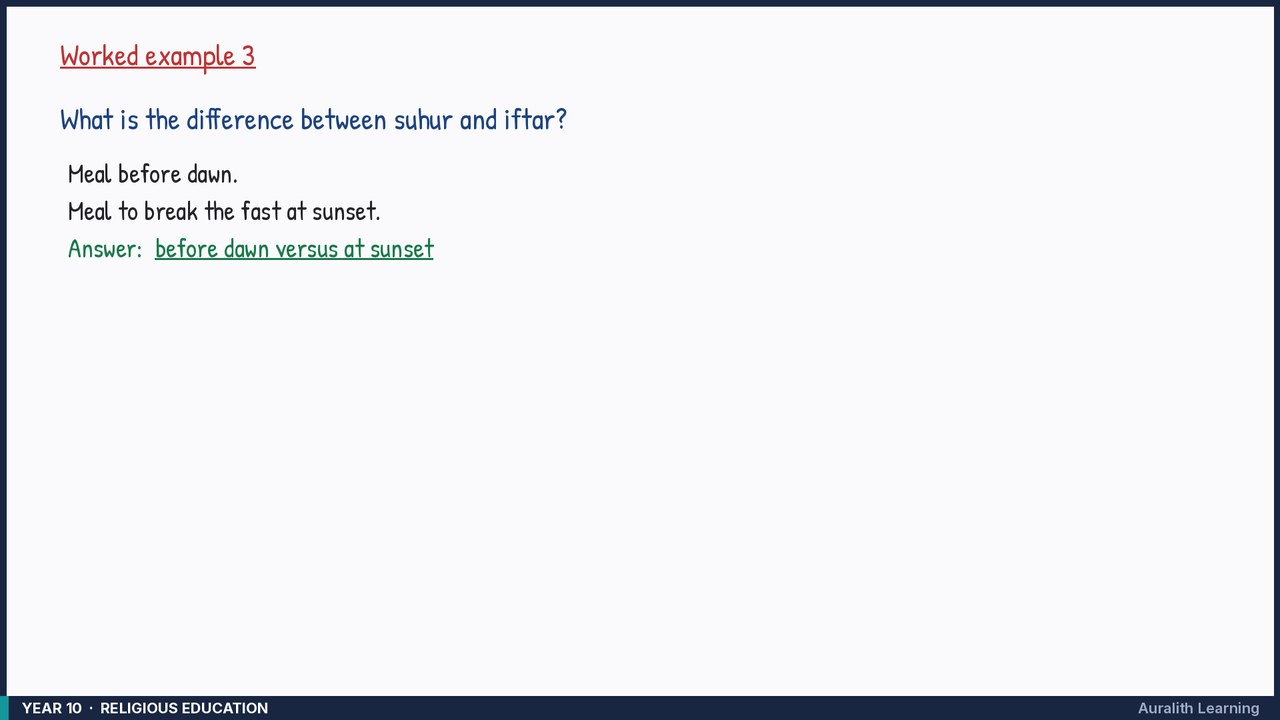
What is the difference between suhur and iftar?
- Step 1: Meal before dawn.
- Step 2: Meal to break the fast at sunset.
Answer: before dawn versus at sunset