Year 10 (ages 14–15, Grade 9 in the US) · Religious education · GCSE Religious Studies · Lesson 11
Living the Christian life: prayer
The purpose and types of Christian prayer — adoration, confession, thanksgiving and supplication — set and informal prayer, the Lord's Prayer as a model, and why prayer matters to Christians.
Exam boards: this lesson matches the AQA and Pearson Edexcel GCSE religious education courses. Check which course your school follows.
8-minute video lesson
Teaching, worked examples and 20 practice questions solved step by step.
Watch free for a monthWhat your child will learn
- Explain the purpose of prayer
- Describe types of prayer
- Compare set and informal prayer
- Explain the importance of the Lord's Prayer
The method
- Prayer: communicating with God.
- Types (ACTS): adoration, confession, thanksgiving, supplication.
- Set prayers (fixed words) vs informal (own words).
- The Lord's Prayer: taught by Jesus; a model for all prayer.
Key words: prayer, set prayer, informal prayer, Lord's Prayer, supplication.
Worked examples
Worked examples from the lesson, with every step.
Question 1
Explain the purpose of prayer for Christians.
- Step 1: Communicate with God.
- Step 2: Builds the relationship; brings guidance and comfort.
Answer: to communicate with God and grow closer to him
Question 2
What does ACTS stand for?
- Step 1: Adoration, Confession.
- Step 2: Thanksgiving, Supplication.
Answer: adoration, confession, thanksgiving, supplication
Question 3
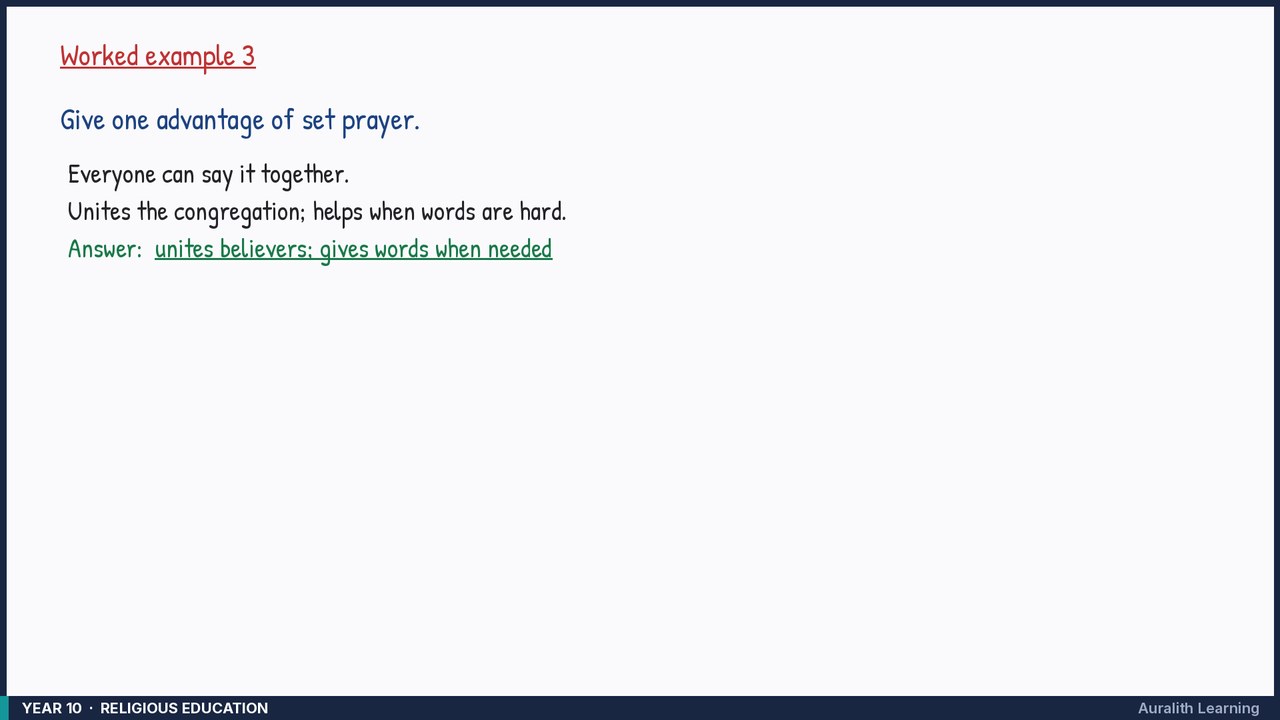
Give one advantage of set prayer.
- Step 1: Everyone can say it together.
- Step 2: Unites the congregation; helps when words are hard.
Answer: unites believers; gives words when needed