Year 10 (ages 14–15, Grade 9 in the US) · Religious education · GCSE Religious Studies · Lesson 23
Muslim beliefs: the Imamate and Sunni and Shi'a Islam
How Sunni and Shi'a Islam developed after the Prophet Muhammad's death, the Sunni caliphs, the Shi'a belief in the Imamate beginning with Ali, the Twelve Imams and the hidden Imam, and why the Imamate matters to Shi'a Muslims today.
Exam boards: this lesson matches the AQA and Pearson Edexcel GCSE religious education courses. Check which course your school follows.
8-minute video lesson
Teaching, worked examples and 20 practice questions solved step by step.
Watch free for a monthWhat your child will learn
- Explain how the Sunni and Shi'a branches began
- Explain the Sunni view of leadership
- Explain the Shi'a belief in the Imamate
- Explain why the Imamate matters to Shi'a Muslims
The method
- After 632 CE, Muslims disagreed on who should lead.
- Sunni: leaders (caliphs) chosen by the community; first was Abu Bakr.
- Shi'a: leaders (Imams) appointed by Allah through the Prophet; first was Ali.
- Twelver Shi'a: twelve Imams; the twelfth is hidden and will return as the Mahdi.
Key words: Imamate, caliph, Ali, Twelve Imams, Mahdi.
Worked examples
Worked examples from the lesson, with every step.
Question 1
Explain why Muslims divided into Sunni and Shi'a.
- Step 1: Death of the Prophet in 632 CE.
- Step 2: Disagreement over who should lead: Abu Bakr or Ali.
Answer: a disagreement over leadership after the Prophet
Question 2
What is the Sunni view of leadership?
- Step 1: Chosen by the community.
- Step 2: Abu Bakr was the first caliph.
Answer: community-chosen caliphs, starting with Abu Bakr
Question 3
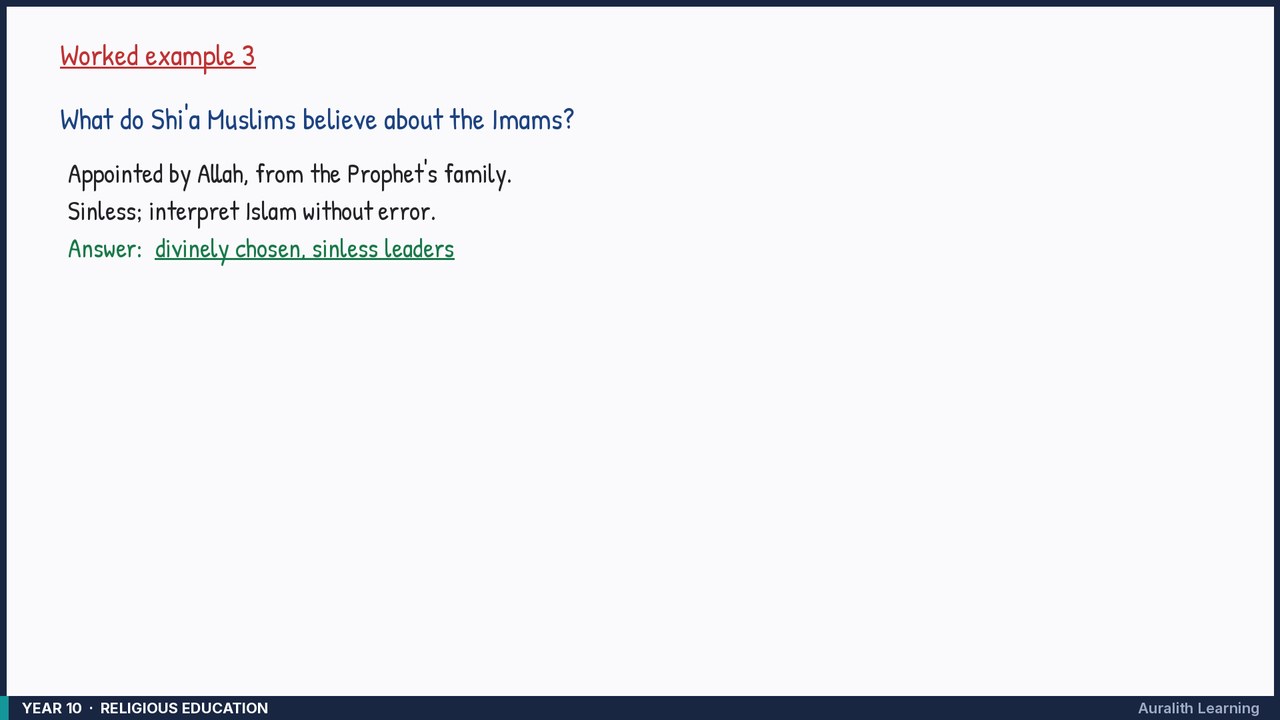
What do Shi'a Muslims believe about the Imams?
- Step 1: Appointed by Allah, from the Prophet's family.
- Step 2: Sinless; interpret Islam without error.
Answer: divinely chosen, sinless leaders