Year 10 (ages 14–15, Grade 9 in the US) · Religious education · GCSE Religious Studies · Lesson 16
Muslim beliefs: the Six Articles of Faith and the Five Roots
The key beliefs of Islam: the Six Articles of Faith in Sunni Islam and the Five Roots of Usul ad-Din in Shi'a Islam, what each belief means, and how they show both shared beliefs and differences between Sunni and Shi'a Muslims.
Exam boards: this lesson matches the AQA and Pearson Edexcel GCSE religious education courses. Check which course your school follows.
8-minute video lesson
Teaching, worked examples and 20 practice questions solved step by step.
Watch free for a monthWhat your child will learn
- List the Six Articles of Faith
- List the Five Roots of Usul ad-Din
- Explain similarities and differences
- Explain why these beliefs matter
The method
- Sunni: Six Articles — Tawhid, angels, holy books, prophets, Akhirah, al-Qadr.
- Shi'a: Five Roots — Tawhid, Adalat, Nubuwwah, Imamah, Mi'ad.
- Shared: one God, prophethood, Day of Judgement.
- Differences: al-Qadr vs Adalat; the Imamate.
Key words: Six Articles of Faith, Usul ad-Din, Sunni, Shi'a, Tawhid.
Worked examples
Worked examples from the lesson, with every step.
Question 1
Name three of the Six Articles of Faith.
- Step 1: Tawhid; angels.
- Step 2: Holy books (or prophethood, Akhirah, al-Qadr).
Answer: e.g. Tawhid, angels, holy books
Question 2
What does Tawhid mean?
- Step 1: The oneness of Allah.
- Step 2: Allah is one, unique and without partners.
Answer: the oneness and uniqueness of Allah
Question 3
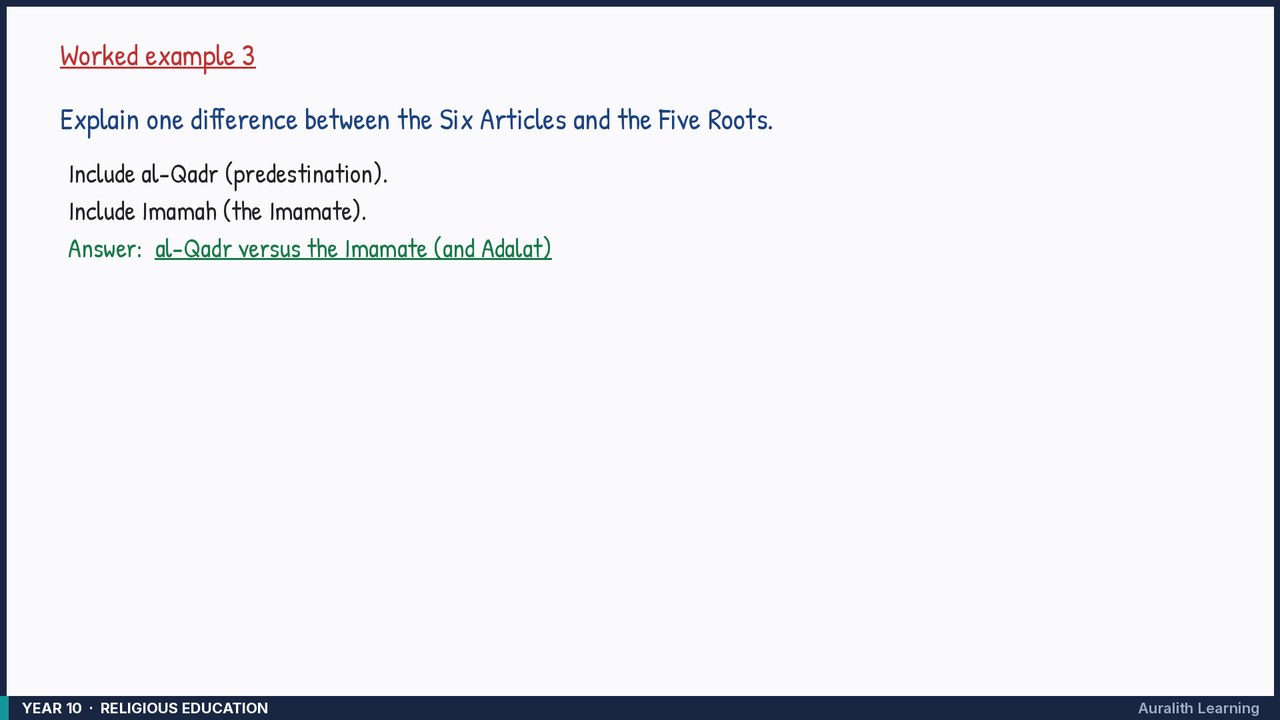
Explain one difference between the Six Articles and the Five Roots.
- Step 1: Include al-Qadr (predestination).
- Step 2: Include Imamah (the Imamate).
Answer: al-Qadr versus the Imamate (and Adalat)