Year 10 (ages 14–15, Grade 9 in the US) · Religious education · GCSE Religious Studies · Lesson 2
Christian beliefs: creation
Christian beliefs about creation from Genesis 1–2 and John 1, the role of the Father, Son and Holy Spirit in creation, different Christian interpretations (literal and non-literal), and what creation teaches about God and humans.
Exam boards: this lesson matches the AQA and Pearson Edexcel GCSE religious education courses. Check which course your school follows.
8-minute video lesson
Teaching, worked examples and 20 practice questions solved step by step.
Watch free for a monthWhat your child will learn
- Describe the Genesis creation accounts
- Explain the role of the Word and the Spirit
- Compare literal and non-literal interpretations
- Explain what creation shows about God and humanity
The method
- Genesis 1: God creates in six days and rests on the seventh.
- John 1: the Word (Jesus) was there and involved in creation.
- Interpretations: literal (creationist) vs non-literal (symbolic).
- Meaning: God is creator, all-powerful, good; humans have a special role.
Key words: creation, Genesis, Word, omnipotence, stewardship.
Worked examples
Worked examples from the lesson, with every step.
Question 1
Outline the Genesis 1 account of creation.
- Step 1: God creates over six days.
- Step 2: Humans on day six; rest on day seven.
Answer: six days of creation, humans last, rest on day seven
Question 2
Explain how John 1 links Jesus to creation.
- Step 1: ‘In the beginning was the Word…’
- Step 2: The Word = Jesus, present at creation.
Answer: the Word, Jesus, was with God and involved in creation
Question 3
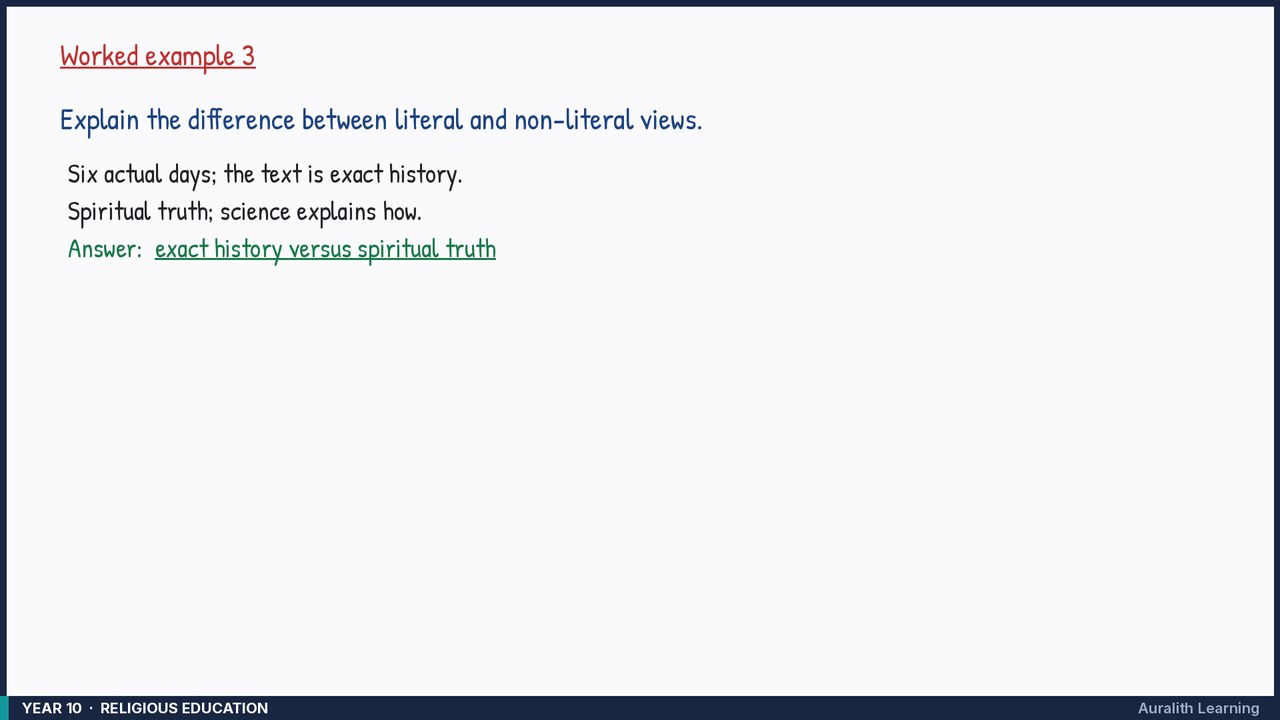
Explain the difference between literal and non-literal views.
- Step 1: Six actual days; the text is exact history.
- Step 2: Spiritual truth; science explains how.
Answer: exact history versus spiritual truth