Year 10 (ages 14–15, Grade 9 in the US) · Religious education · GCSE Religious Studies · Lesson 19
Muslim beliefs: the holy books
The Muslim holy books — the Qur'an, the Tawrat, the Zabur, the Injil and the Scrolls of Ibrahim — how the Qur'an was revealed and compiled, why it is seen as the final and unchanged word of Allah, and how Muslims treat it.
Exam boards: this lesson matches the AQA and Pearson Edexcel GCSE religious education courses. Check which course your school follows.
8-minute video lesson
Teaching, worked examples and 20 practice questions solved step by step.
Watch free for a monthWhat your child will learn
- Name the holy books in Islam
- Explain how the Qur'an was revealed
- Explain the authority of the Qur'an
- Describe how Muslims show respect for the Qur'an
The method
- Holy books: Qur'an, Tawrat, Zabur, Injil, Scrolls of Ibrahim.
- Qur'an revealed to the Prophet Muhammad over about 23 years.
- Seen as Allah's exact, final and unchanged word, in Arabic.
- Respect: wudu before touching; kept high; memorised (hafiz).
Key words: Qur'an, revelation, Tawrat, Injil, authority.
Worked examples
Worked examples from the lesson, with every step.
Question 1
Name three holy books in Islam.
- Step 1: The Qur'an.
- Step 2: The Tawrat and the Injil.
Answer: Qur'an, Tawrat, Injil (also Zabur, Scrolls of Ibrahim)
Question 2
Describe how the Qur'an was first revealed.
- Step 1: Cave of Hira, 610 CE.
- Step 2: Jibril told the Prophet to ‘recite’.
Answer: through Jibril in the cave of Hira in 610 CE
Question 3
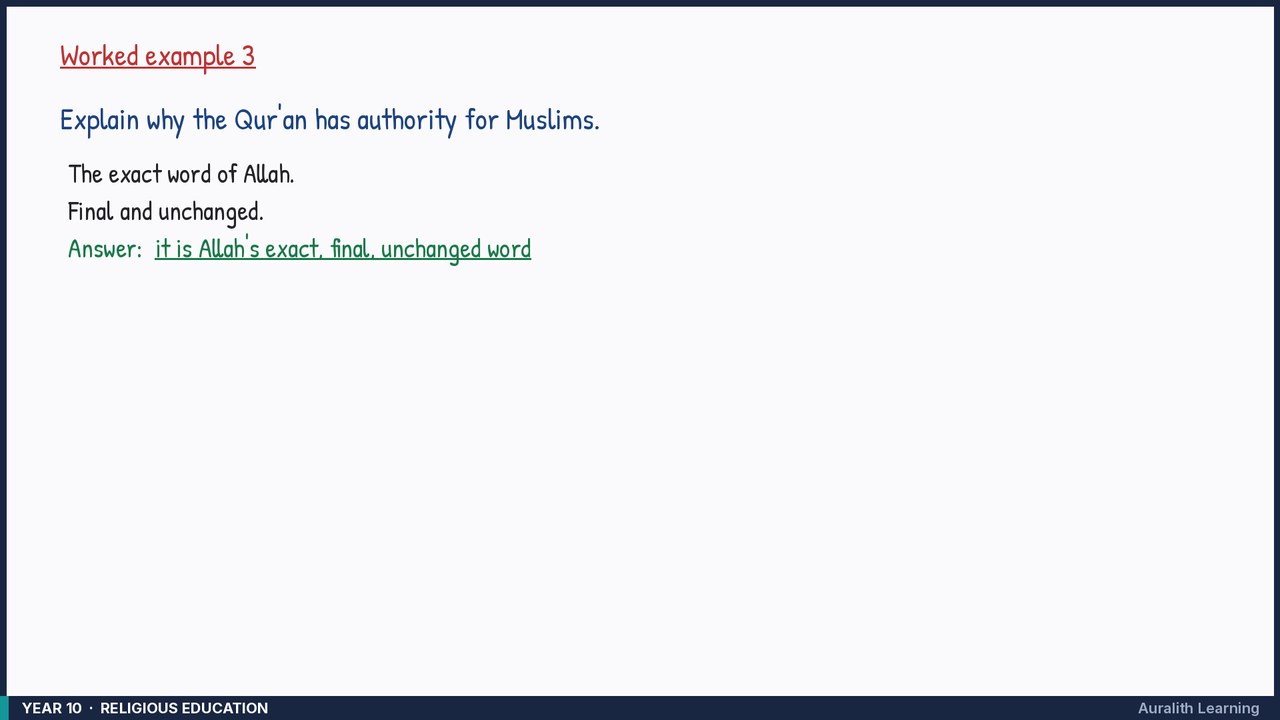
Explain why the Qur'an has authority for Muslims.
- Step 1: The exact word of Allah.
- Step 2: Final and unchanged.
Answer: it is Allah's exact, final, unchanged word