Year 10 (ages 14–15, Grade 9 in the US) · Religious education · GCSE Religious Studies · Lesson 9
Living the Christian life: worship
The different forms of Christian worship — liturgical, non-liturgical, informal and private — with examples from different denominations, and why worship is important to Christians.
Exam boards: this lesson matches the AQA and Pearson Edexcel GCSE religious education courses. Check which course your school follows.
8-minute video lesson
Teaching, worked examples and 20 practice questions solved step by step.
Watch free for a monthWhat your child will learn
- Describe liturgical worship
- Describe non-liturgical and informal worship
- Explain private worship
- Explain why worship matters
The method
- Liturgical: set pattern of words and actions (e.g. Catholic Mass).
- Non-liturgical: no fixed pattern; Bible-focused (e.g. many Protestant churches).
- Informal: spontaneous, e.g. Pentecostal; Quaker silent meetings.
- Private: personal prayer, Bible reading.
Key words: worship, liturgical, non-liturgical, informal worship, private worship.
Worked examples
Worked examples from the lesson, with every step.
Question 1
Describe liturgical worship.
- Step 1: Set order of service, written prayers.
- Step 2: The Catholic Mass.
Answer: worship following a set pattern, e.g. Mass
Question 2
Describe a Quaker meeting for worship.
- Step 1: Mostly silent.
- Step 2: Anyone may speak if moved by the Spirit.
Answer: silent worship where anyone may speak
Question 3
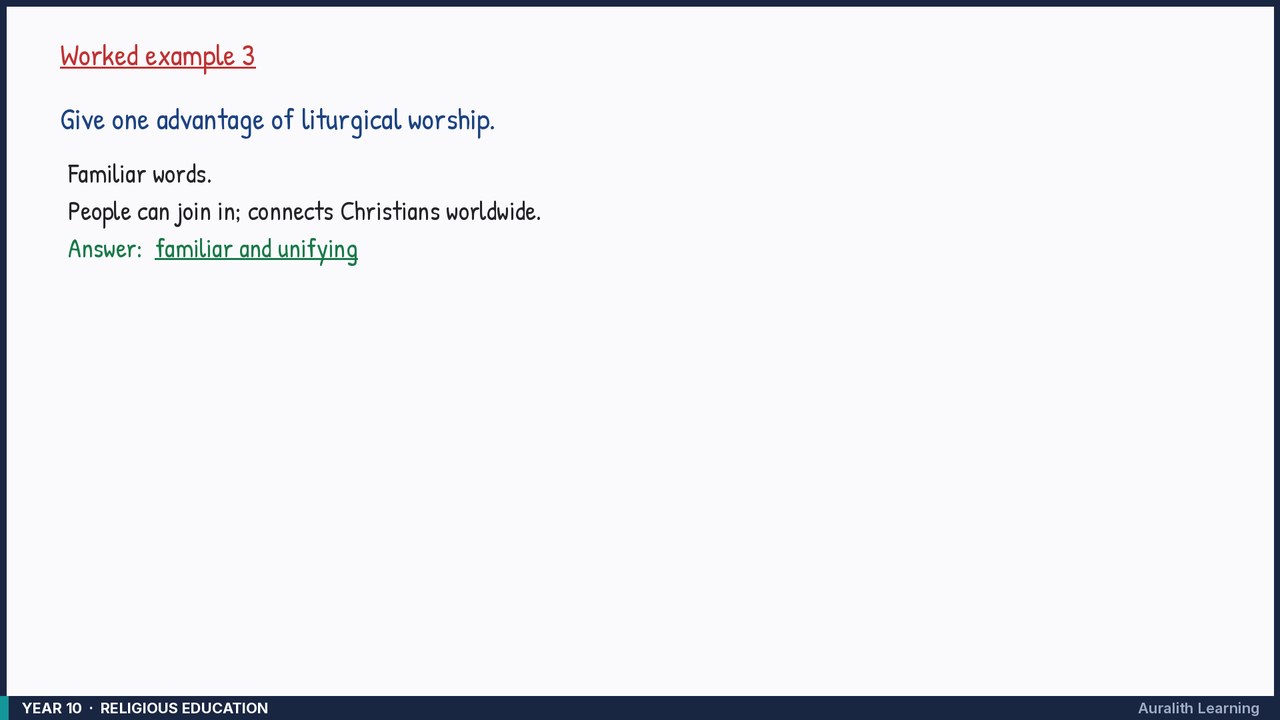
Give one advantage of liturgical worship.
- Step 1: Familiar words.
- Step 2: People can join in; connects Christians worldwide.
Answer: familiar and unifying