Year 10 (ages 14–15, Grade 9 in the US) · Religious education · GCSE Religious Studies · Lesson 3
Christian beliefs: the incarnation
The Christian belief that Jesus is God incarnate — fully God and fully human — the virgin birth in Matthew and Luke, the titles Son of God and Messiah, and why the incarnation matters for Christians.
Exam boards: this lesson matches the AQA and Pearson Edexcel GCSE religious education courses. Check which course your school follows.
8-minute video lesson
Teaching, worked examples and 20 practice questions solved step by step.
Watch free for a monthWhat your child will learn
- Explain the incarnation
- Describe the virgin birth accounts
- Explain the titles Son of God and Christ
- Explain the significance of the incarnation
The method
- Incarnation: God became human in Jesus.
- Jesus is fully God and fully human.
- Evidence: virgin birth (Matthew 1, Luke 1–2); John 1:14.
- Significance: God understands humans; makes salvation possible.
Key words: incarnation, virgin birth, Messiah, Son of God, Emmanuel.
Worked examples
Worked examples from the lesson, with every step.
Question 1
Explain the meaning of the incarnation.
- Step 1: God became human in Jesus.
- Step 2: Fully God and fully human.
Answer: God taking human form in Jesus, fully God and fully human
Question 2
Give one biblical source for the incarnation.
- Step 1: John 1:14.
- Step 2: ‘the Word was made flesh, and dwelt among us’
Answer: John 1:14 (or Matthew 1, Luke 1)
Question 3
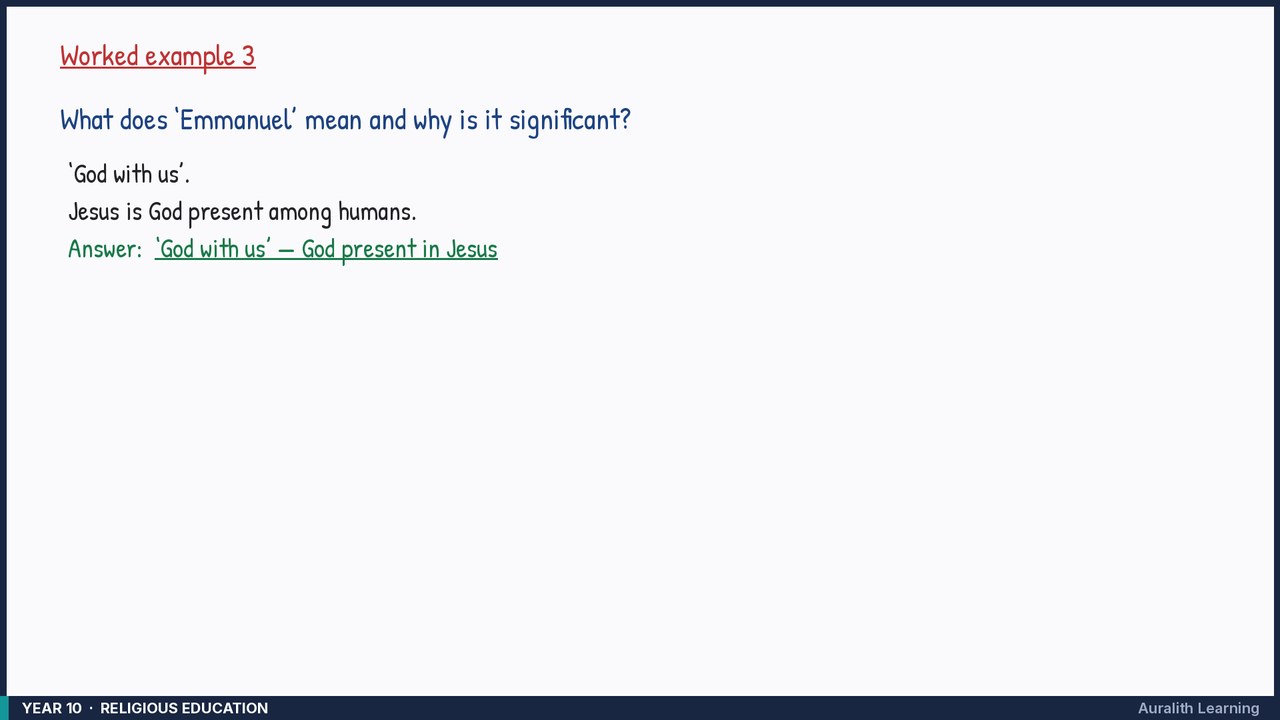
What does ‘Emmanuel’ mean and why is it significant?
- Step 1: ‘God with us’.
- Step 2: Jesus is God present among humans.
Answer: ‘God with us’ — God present in Jesus