Year 10 (ages 14–15, Grade 9 in the US) · Religious education · GCSE Religious Studies · Lesson 28
Muslim practices: Hajj (pilgrimage)
Hajj, the pilgrimage to Makkah: who must go, ihram, the main stages including tawaf, sa'y, Arafat, Muzdalifah and Mina, their origins in the stories of Ibrahim, Hajar and Isma'il, and the significance and challenges of Hajj.
Exam boards: this lesson matches the AQA and Pearson Edexcel GCSE religious education courses. Check which course your school follows.
8-minute video lesson
Teaching, worked examples and 20 practice questions solved step by step.
Watch free for a monthWhat your child will learn
- Explain who must perform Hajj
- Describe the stages of Hajj
- Explain the origins of the rituals
- Explain the significance of Hajj
The method
- Hajj: once in a lifetime if healthy and able to afford it.
- In Dhul-Hijjah, the twelfth month.
- Ihram, tawaf, sa'y, Arafat, Muzdalifah, Mina, sacrifice, final tawaf.
- Shows equality, unity, forgiveness and submission.
Key words: Hajj, ihram, tawaf, Arafat, Mina.
Worked examples
Worked examples from the lesson, with every step.
Question 1
Who is expected to perform Hajj?
- Step 1: Adult Muslims who are healthy and can afford it.
- Step 2: Once in a lifetime.
Answer: able adult Muslims, once in a lifetime
Question 2
Describe tawaf.
- Step 1: Walking around the Ka'bah.
- Step 2: Seven times, anticlockwise.
Answer: circling the Ka'bah seven times
Question 3
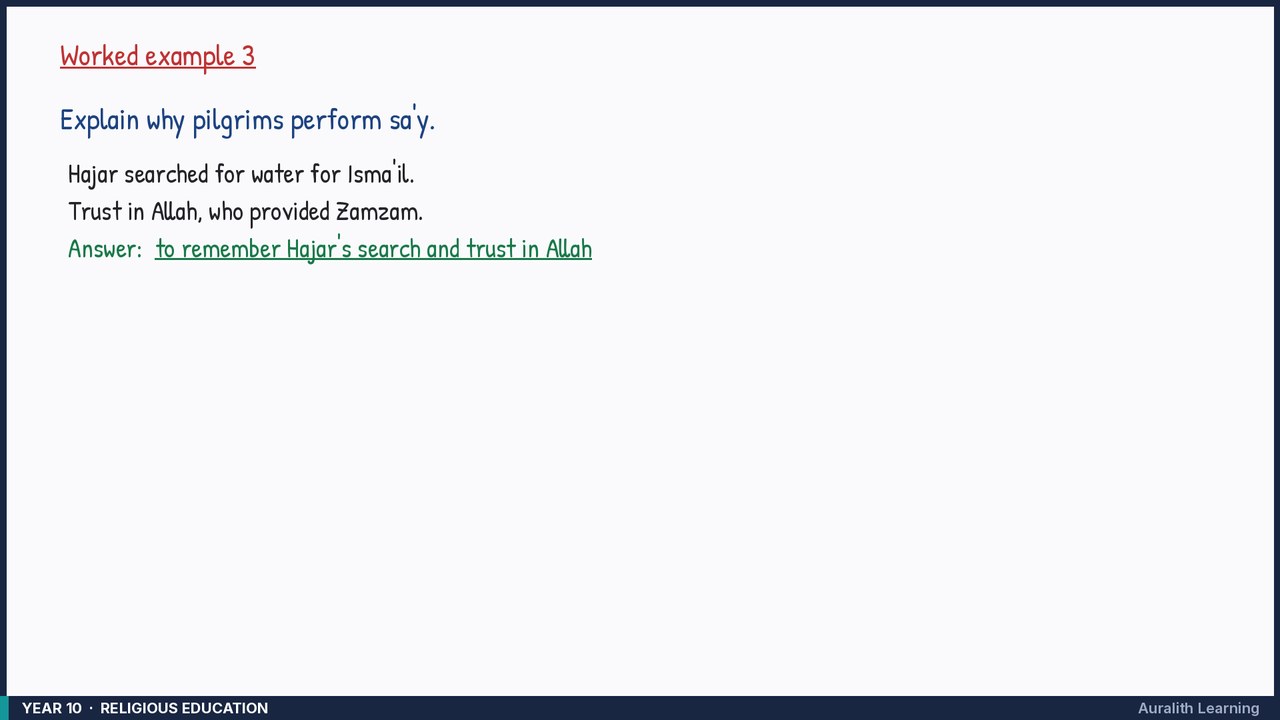
Explain why pilgrims perform sa'y.
- Step 1: Hajar searched for water for Isma'il.
- Step 2: Trust in Allah, who provided Zamzam.
Answer: to remember Hajar's search and trust in Allah