Year 10 (ages 14–15, Grade 9 in the US) · Religious education · GCSE Religious Studies · Lesson 25
Muslim practices: Salah (prayer)
Salah, the daily prayers in Islam: the five prayer times, wudu, facing the qiblah, the actions of a rak'ah, Friday Jummah prayer at the mosque, differences in Sunni and Shi'a practice, and why prayer matters to Muslims.
Exam boards: this lesson matches the AQA and Pearson Edexcel GCSE religious education courses. Check which course your school follows.
8-minute video lesson
Teaching, worked examples and 20 practice questions solved step by step.
Watch free for a monthWhat your child will learn
- Describe the five daily prayers
- Explain wudu and the qiblah
- Describe the actions of prayer
- Explain why Salah is important
The method
- Five daily prayers: Fajr, Zuhr, Asr, Maghrib, Isha.
- Wudu (ritual washing) before praying; face the qiblah (towards Makkah).
- Rak'ah: a set sequence of standing, bowing, prostrating and sitting.
- Jummah: Friday midday prayer at the mosque with a sermon.
Key words: Salah, wudu, qiblah, rak'ah, Jummah.
Worked examples
Worked examples from the lesson, with every step.
Question 1
Name the five daily prayers.
- Step 1: Fajr, Zuhr, Asr.
- Step 2: Maghrib, Isha.
Answer: Fajr, Zuhr, Asr, Maghrib, Isha
Question 2
Explain why Muslims perform wudu.
- Step 1: Ritual washing before prayer.
- Step 2: Purity before Allah.
Answer: to be pure before Allah
Question 3
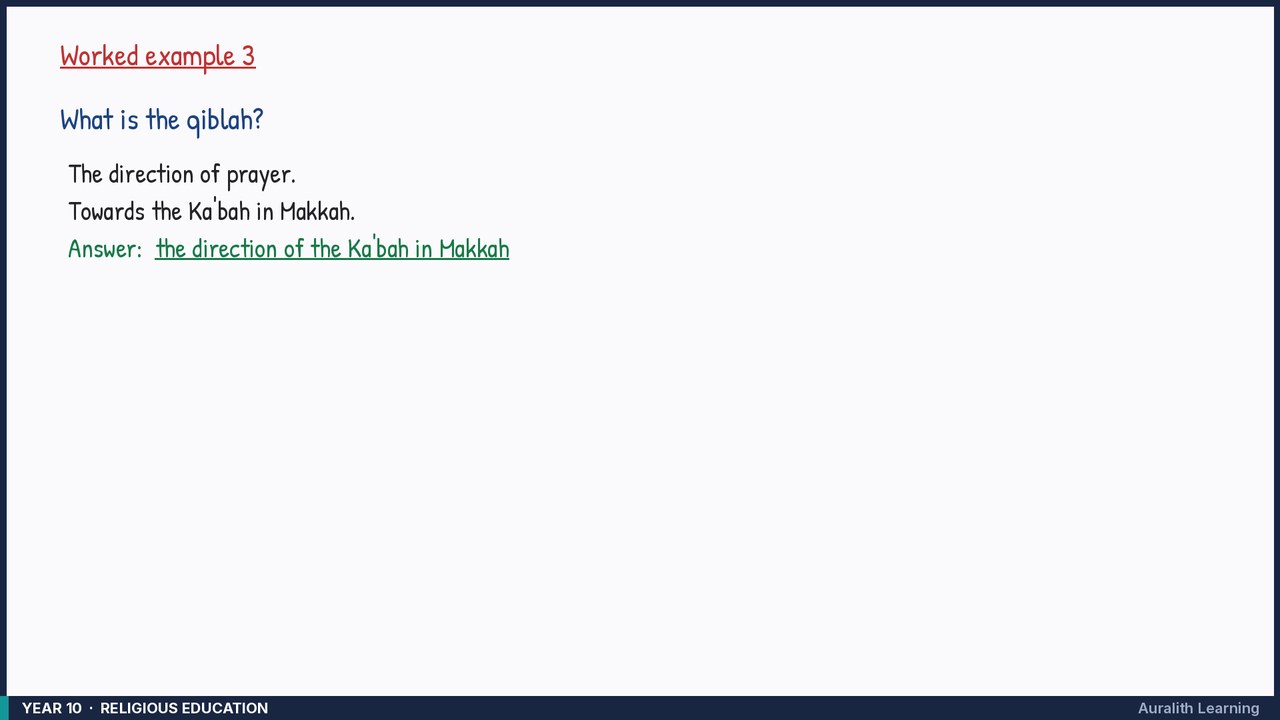
What is the qiblah?
- Step 1: The direction of prayer.
- Step 2: Towards the Ka'bah in Makkah.
Answer: the direction of the Ka'bah in Makkah