Year 10 (ages 14–15, Grade 9 in the US) · Religious education · GCSE Religious Studies · Lesson 24
Muslim practices: the Five Pillars, the Ten Obligatory Acts and Shahadah
The Five Pillars of Sunni Islam and the Ten Obligatory Acts of Shi'a Islam, how they compare, and the Shahadah — the declaration of faith — including what it means and when it is said.
Exam boards: this lesson matches the AQA and Pearson Edexcel GCSE religious education courses. Check which course your school follows.
8-minute video lesson
Teaching, worked examples and 20 practice questions solved step by step.
Watch free for a monthWhat your child will learn
- List the Five Pillars
- List the Ten Obligatory Acts
- Explain the meaning of the Shahadah
- Explain why the Shahadah is important
The method
- Five Pillars: Shahadah, Salah, Zakah, Sawm, Hajj.
- Ten Obligatory Acts (Shi'a): Salah, Sawm, Zakah, Khums, Hajj, Jihad, amr bil-ma'ruf, nahi anil-munkar, tawalla, tabarra.
- Shahadah: belief in one God and in Muhammad as his messenger.
- Said at birth, conversion, in daily prayer and before death.
Key words: Five Pillars, Ten Obligatory Acts, Shahadah, ummah, adhan.
Worked examples
Worked examples from the lesson, with every step.
Question 1
Name the Five Pillars of Islam.
- Step 1: Shahadah, Salah, Zakah.
- Step 2: Sawm, Hajj.
Answer: Shahadah, Salah, Zakah, Sawm, Hajj
Question 2
Name two Obligatory Acts that are not among the Five Pillars.
- Step 1: Khums.
- Step 2: Jihad (or tawalla, tabarra...).
Answer: e.g. Khums, Jihad
Question 3
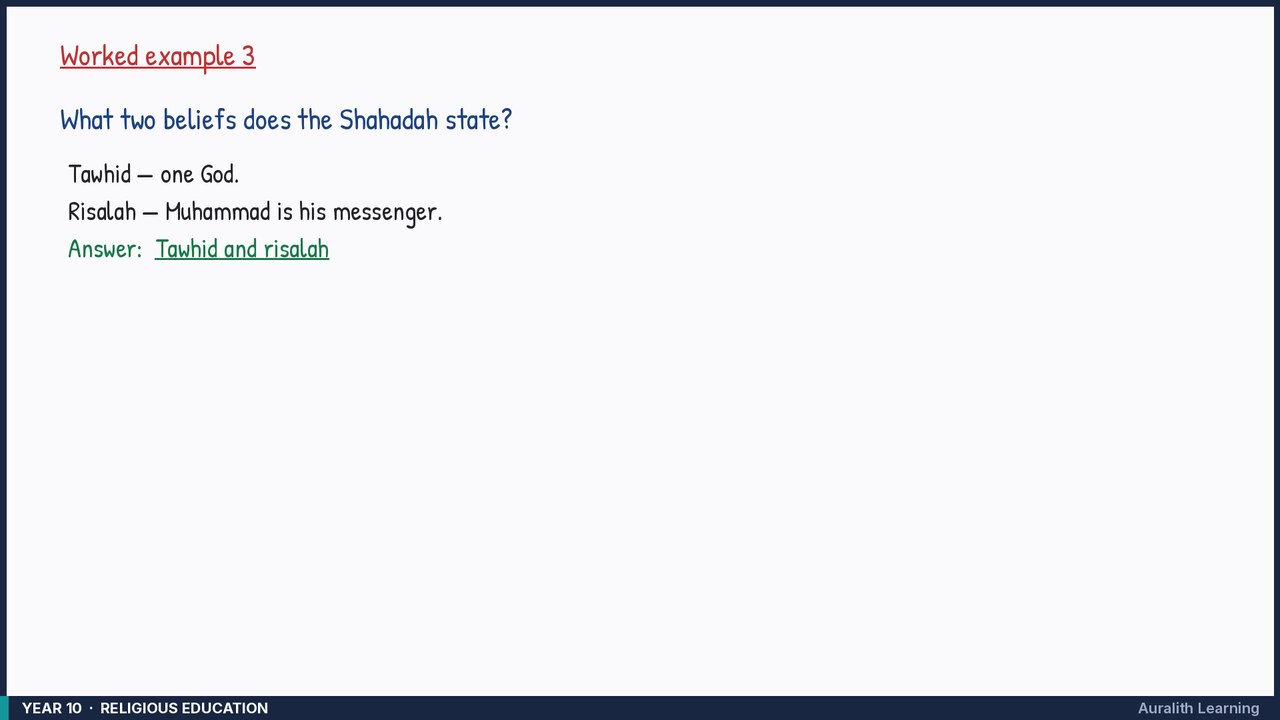
What two beliefs does the Shahadah state?
- Step 1: Tawhid — one God.
- Step 2: Risalah — Muhammad is his messenger.
Answer: Tawhid and risalah