Year 10 (ages 14–15, Grade 9 in the US) · Religious education · GCSE Religious Studies · Lesson 1
Christian beliefs: the Trinity
The Christian belief in the Trinity — one God as Father, Son and Holy Spirit — its basis in the Bible, how it is expressed in the Nicene Creed, and why it matters for how Christians worship and live.
Exam boards: this lesson matches the AQA and Pearson Edexcel GCSE religious education courses. Check which course your school follows.
9-minute video lesson
Teaching, worked examples and 20 practice questions solved step by step.
Watch free for a monthWhat your child will learn
- Explain the Trinity
- Describe the role of each person of the Trinity
- Use biblical evidence
- Explain why the Trinity matters to Christians
The method
- One God in three persons: Father, Son, Holy Spirit.
- Each fully God; not three gods.
- Evidence: Jesus' baptism; Matthew 28:19; the Nicene Creed.
- Significance: worship, prayer, relationship with God.
Key words: Trinity, monotheism, Nicene Creed, Holy Spirit, incarnation.
Worked examples
Worked examples from the lesson, with every step.
Question 1
Explain what Christians mean by the Trinity.
- Step 1: One God in three persons.
- Step 2: Father, Son, Holy Spirit — each fully God.
Answer: one God as Father, Son and Holy Spirit
Question 2
Describe the role of the Holy Spirit.
- Step 1: God's presence in the world today.
- Step 2: Guides and strengthens believers.
Answer: God active and present in believers and the world
Question 3
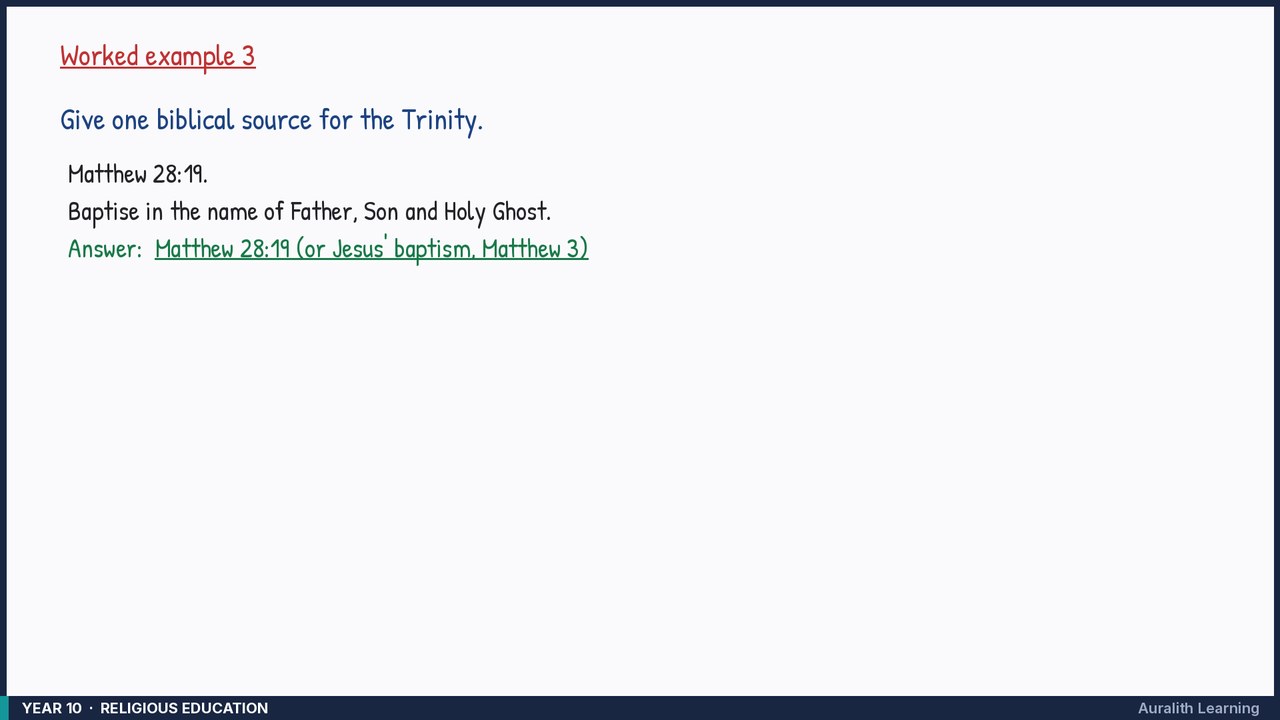
Give one biblical source for the Trinity.
- Step 1: Matthew 28:19.
- Step 2: Baptise in the name of Father, Son and Holy Ghost.
Answer: Matthew 28:19 (or Jesus' baptism, Matthew 3)