Year 10 (ages 14–15, Grade 9 in the US) · Religious education · GCSE Religious Studies · Lesson 10
Living the Christian life: the sacraments
What a sacrament is, how many sacraments different denominations recognise, infant and believers' baptism, the Eucharist and its different interpretations, and why the Quakers and the Salvation Army do not practise sacraments.
Exam boards: this lesson matches the AQA and Pearson Edexcel GCSE religious education courses. Check which course your school follows.
8-minute video lesson
Teaching, worked examples and 20 practice questions solved step by step.
Watch free for a monthWhat your child will learn
- Define a sacrament
- Compare infant and believers' baptism
- Explain different views of the Eucharist
- Explain differences between denominations
The method
- Sacrament: an outward sign of an inward grace.
- Catholics and Orthodox: seven; most Protestants: two (baptism, Eucharist).
- Baptism: infant (most churches) or believers' (Baptists).
- Eucharist: real presence (Catholic) vs memorial (many Protestants).
Key words: sacrament, baptism, Eucharist, transubstantiation, denomination.
Worked examples
Worked examples from the lesson, with every step.
Question 1
Define a sacrament.
- Step 1: An outward sign of an inward grace.
- Step 2: A ritual where God's grace is received.
Answer: an outward sign of an inward grace
Question 2
Explain one difference between infant and believers' baptism.
- Step 1: Parents decide; baby can't choose.
- Step 2: The person chooses as an adult.
Answer: who makes the choice
Question 3
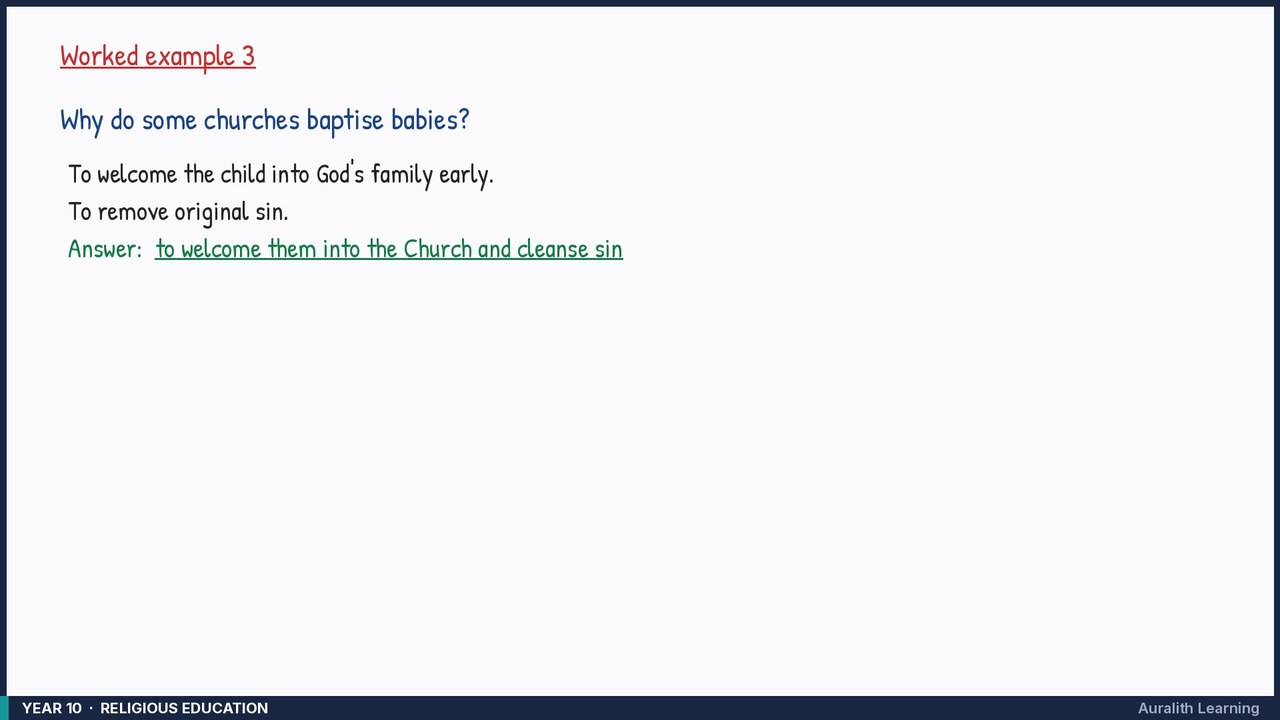
Why do some churches baptise babies?
- Step 1: To welcome the child into God's family early.
- Step 2: To remove original sin.
Answer: to welcome them into the Church and cleanse sin