Year 10 (ages 14–15, Grade 9 in the US) · Religious education · GCSE Religious Studies · Lesson 21
Muslim beliefs: predestination (al-Qadr)
Al-Qadr, the Muslim belief that Allah knows and decrees everything, how Muslims balance predestination with human free will, different Sunni and Shi'a emphases, and how the belief links to the Day of Judgement and daily life.
Exam boards: this lesson matches the AQA and Pearson Edexcel GCSE religious education courses. Check which course your school follows.
8-minute video lesson
Teaching, worked examples and 20 practice questions solved step by step.
Watch free for a monthWhat your child will learn
- Explain al-Qadr
- Explain the link between predestination and free will
- Compare Sunni and Shi'a emphases
- Explain how al-Qadr affects Muslims
The method
- Al-Qadr: Allah knows and has decreed all that happens.
- Humans still have free will and are responsible for choices.
- Sunni: stress Allah's decree; Shi'a: stress Allah's justice and human choice.
- Effect: trust in Allah, patience, saying insha'Allah.
Key words: al-Qadr, predestination, free will, Day of Judgement, insha'Allah.
Worked examples
Worked examples from the lesson, with every step.
Question 1
Explain what Muslims mean by al-Qadr.
- Step 1: Allah knows and decrees all.
- Step 2: Nothing happens outside his will.
Answer: predestination: Allah knows and decrees everything
Question 2
How can Muslims believe in both al-Qadr and free will?
- Step 1: Allah knows what we will choose.
- Step 2: We still freely make the choice.
Answer: knowing a choice is not forcing it
Question 3
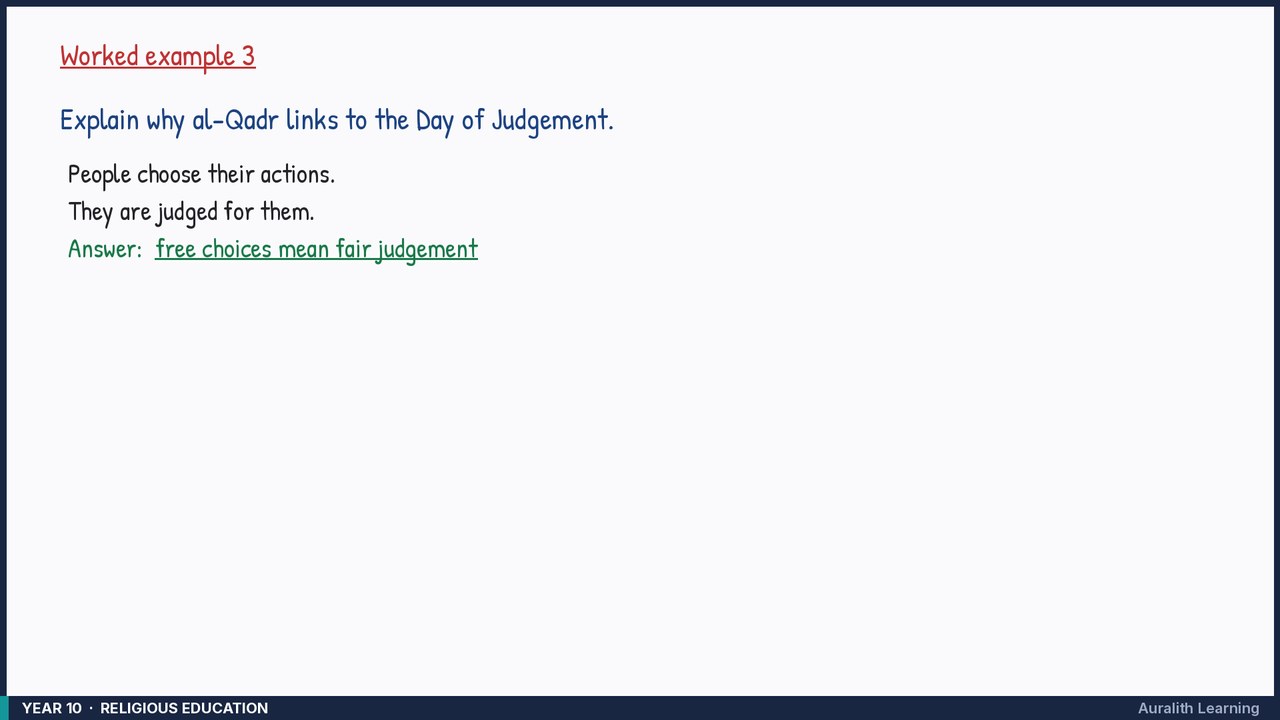
Explain why al-Qadr links to the Day of Judgement.
- Step 1: People choose their actions.
- Step 2: They are judged for them.
Answer: free choices mean fair judgement