Year 10 (ages 14–15, Grade 9 in the US) · Computing · GCSE theory · Lesson 11
Networks: LANs, WANs and performance
What a network is and why we use one, the difference between a LAN and a WAN, client–server and peer-to-peer models, and the factors that affect network performance.
Exam boards: this lesson matches the AQA and Pearson Edexcel GCSE computing courses. Check which course your school follows.
8-minute video lesson
Teaching, worked examples and 20 practice questions solved step by step.
Watch free for a monthWhat your child will learn
- Define LAN and WAN
- Compare client–server and peer-to-peer
- Explain factors affecting performance
- Give benefits and drawbacks of networks
The method
- LAN: small area, own hardware. WAN: large area, rented links.
- Client–server: central server provides services.
- Peer-to-peer: computers share equally.
- Performance: bandwidth, users, transmission media, errors, distance.
Key words: LAN, WAN, client–server, peer-to-peer, bandwidth.
Worked examples
Worked examples from the lesson, with every step.
Question 1
Is a school network a LAN or WAN?
- Step 1: One site.
- Step 2: LAN.
Answer: LAN
Question 2
Give one advantage of client–server.
- Step 1: Central server.
- Step 2: Easy to back up and manage security.
Answer: central backup and security
Question 3
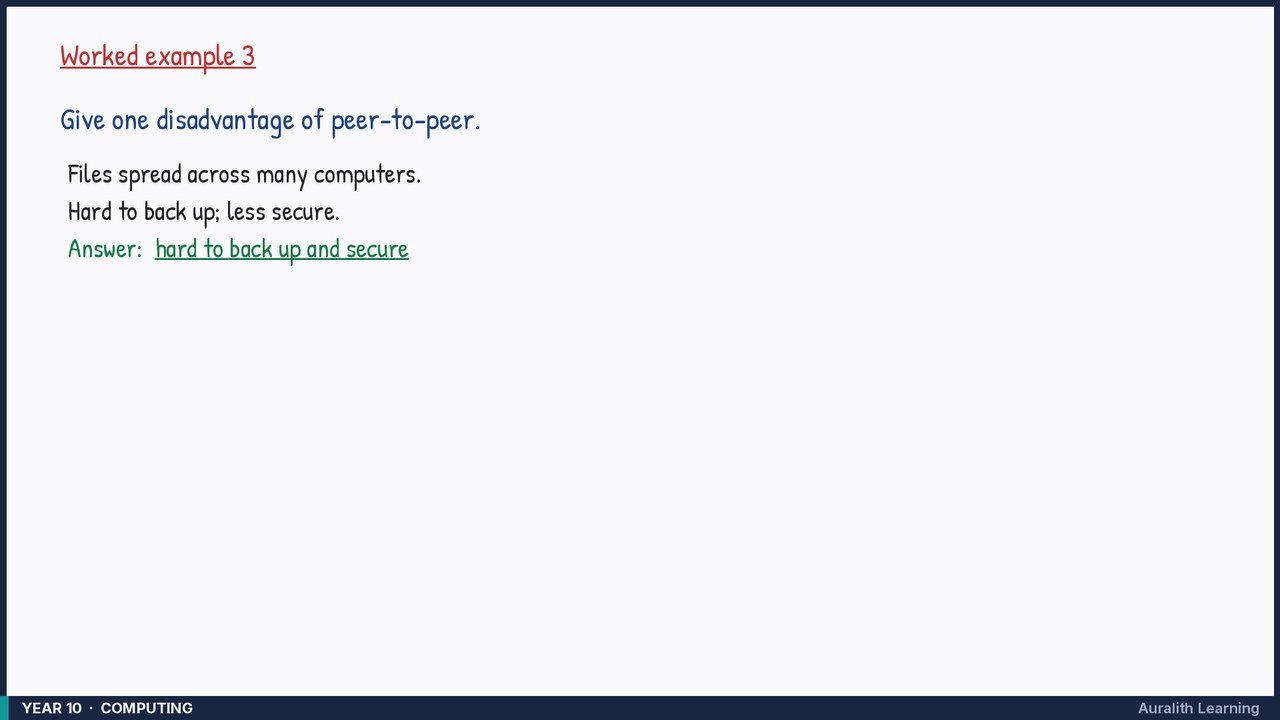
Give one disadvantage of peer-to-peer.
- Step 1: Files spread across many computers.
- Step 2: Hard to back up; less secure.
Answer: hard to back up and secure