Year 10 (ages 14–15, Grade 9 in the US) · Computing · GCSE theory · Lesson 3
Binary addition and binary shifts
Adding two 8-bit binary numbers using the four addition rules, recognising overflow errors, and using left and right binary shifts to multiply and divide by powers of 2.
Exam boards: this lesson matches the AQA and Pearson Edexcel GCSE computing courses. Check which course your school follows.
10-minute video lesson
Teaching, worked examples and 20 practice questions solved step by step.
Watch free for a monthWhat your child will learn
- Add two 8-bit binary numbers
- Explain overflow
- Perform left and right shifts
- Explain the effect of shifts on value
The method
- Rules: 0+0=0, 0+1=1, 1+1=10 (carry 1), 1+1+1=11 (carry 1).
- Work right to left, writing carries above.
- Carry out of the 8th bit = overflow.
- Left shift ×2 per place; right shift ÷2 per place.
Key words: binary addition, carry, overflow, logical shift, most significant bit.
Worked examples
Worked examples from the lesson, with every step.
Question 1
Add 0101 0011 and 0011 0110.
- Step 1: 0101 0011 + 0011 0110 = 1000 1001
- Step 2: 83 + 54 = 137 ✓
Answer: 1000 1001
Question 2
Add 0000 1111 and 0000 0001.
- Step 1: 1 + 1 carries through four columns.
- Step 2: 0001 0000 (15 + 1 = 16)
Answer: 0001 0000
Question 3
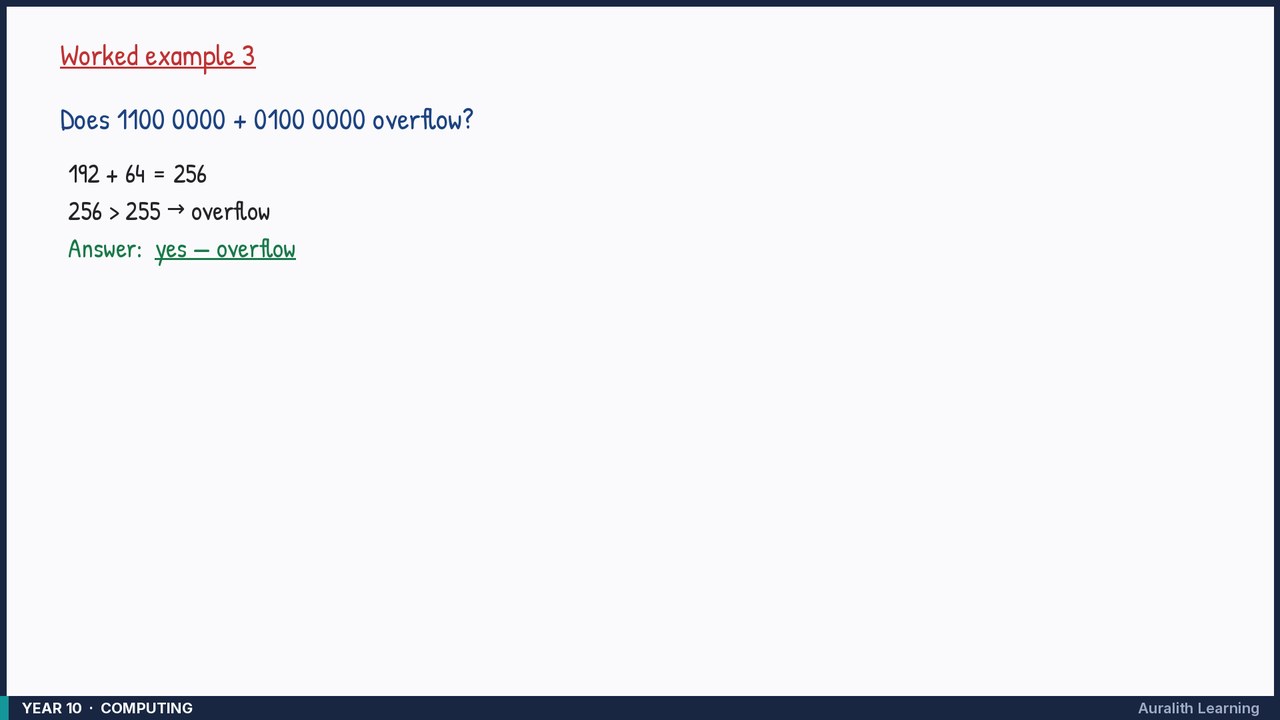
Does 1100 0000 + 0100 0000 overflow?
- Step 1: 192 + 64 = 256
- Step 2: 256 > 255 → overflow
Answer: yes — overflow