Year 10 (ages 14–15, Grade 9 in the US) · Computing · GCSE theory · Lesson 7
The CPU and the fetch–execute cycle
The purpose of the CPU, its main components (ALU, control unit, cache and registers), von Neumann architecture, and the stages of the fetch–decode–execute cycle.
Exam boards: this lesson matches the AQA and Pearson Edexcel GCSE computing courses. Check which course your school follows.
8-minute video lesson
Teaching, worked examples and 20 practice questions solved step by step.
Watch free for a monthWhat your child will learn
- State the purpose of the CPU
- Describe the ALU, CU, cache and registers
- Explain von Neumann architecture
- Describe the fetch–decode–execute cycle
The method
- CPU: fetches and executes instructions.
- Components: ALU, CU, cache, registers.
- Von Neumann: data and instructions stored together in memory.
- Cycle: fetch → decode → execute, repeated.
Key words: CPU, ALU, control unit, register, fetch–decode–execute.
Worked examples
Worked examples from the lesson, with every step.
Question 1
State the purpose of the ALU.
- Step 1: Calculations such as addition.
- Step 2: Comparisons such as greater than.
Answer: arithmetic and logic operations
Question 2
What does the program counter hold?
- Step 1: An address.
- Step 2: Of the next instruction.
Answer: the address of the next instruction
Question 3
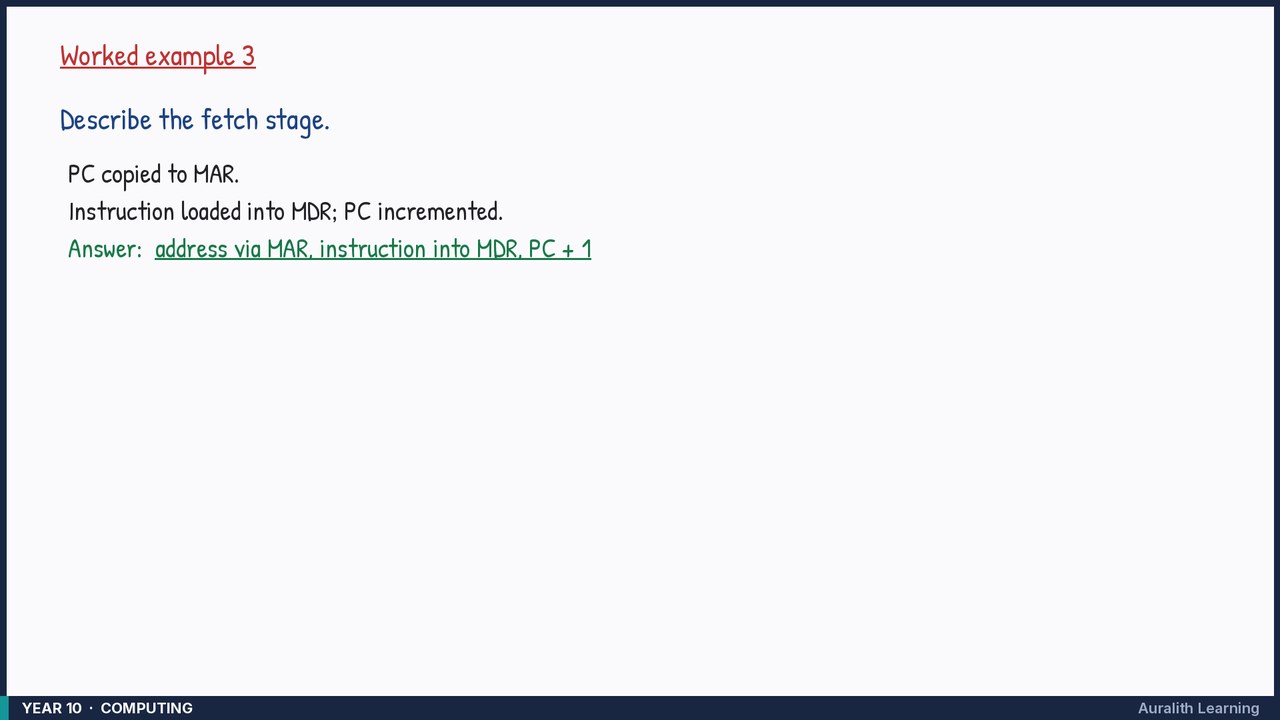
Describe the fetch stage.
- Step 1: PC copied to MAR.
- Step 2: Instruction loaded into MDR; PC incremented.
Answer: address via MAR, instruction into MDR, PC + 1