Year 10 (ages 14–15, Grade 9 in the US) · Computing · GCSE theory · Lesson 20
Artificial intelligence and its impact
What artificial intelligence and machine learning are, how a model learns from training data, everyday uses of AI, and the benefits and risks, including bias, misinformation, privacy and effects on jobs, with balanced discussion.
Exam boards: this lesson matches the Pearson Edexcel GCSE computing courses. Check which course your school follows.
8-minute video lesson
Teaching, worked examples and 20 practice questions solved step by step.
Watch free for a monthWhat your child will learn
- Define AI and machine learning
- Explain the role of training data
- Describe uses of AI
- Evaluate benefits and risks of AI
The method
- AI: computers doing tasks that usually need human intelligence.
- Machine learning: learning patterns from data, not fixed rules.
- Quality of data → quality of results.
- Evaluate: benefits, risks, stakeholders, judgement.
Key words: artificial intelligence, machine learning, training data, bias, deepfake.
Worked examples
Worked examples from the lesson, with every step.
Question 1
How is machine learning different from a normal program?
- Step 1: Follows rules written by a programmer.
- Step 2: Learns patterns from data.
Answer: it learns from data instead of fixed rules
Question 2
Why does training data matter?
- Step 1: The model learns only from its data.
- Step 2: Biased or poor data → biased or poor results.
Answer: results depend on data quality
Question 3
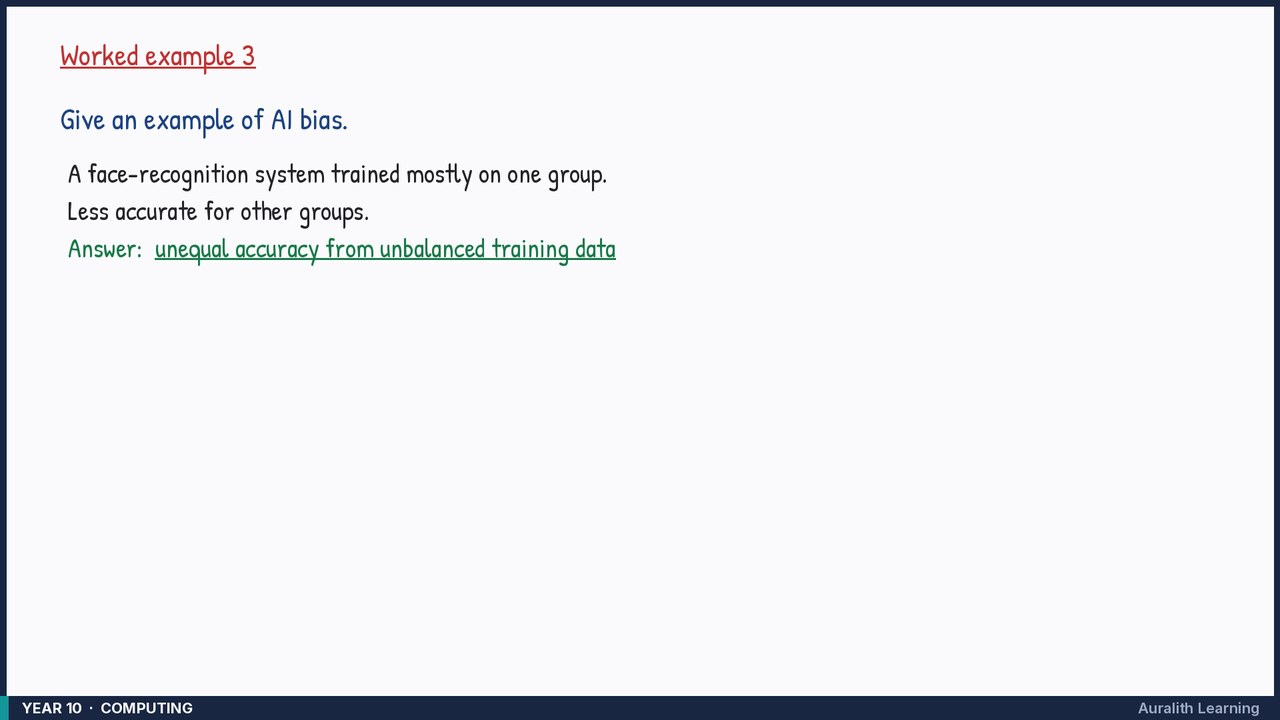
Give an example of AI bias.
- Step 1: A face-recognition system trained mostly on one group.
- Step 2: Less accurate for other groups.
Answer: unequal accuracy from unbalanced training data