Year 10 (ages 14–15, Grade 9 in the US) · Geography · GCSE physical geography · Lesson 5
Typhoon Haiyan and reducing storm risk
The effects of and responses to Typhoon Haiyan in the Philippines in 2013, and how monitoring, prediction, protection and planning reduce the effects of tropical storms.
Exam boards: this lesson matches the AQA GCSE geography courses. Check which course your school follows.
8-minute video lesson
Teaching, worked examples and 20 practice questions solved step by step.
Watch free for a monthWhat your child will learn
- Describe the primary and secondary effects of Haiyan
- Describe immediate and long-term responses
- Explain how storm risk can be reduced
- Evaluate the strategies
The method
- Case study: when, where, how strong.
- Effects: primary vs secondary.
- Responses: immediate vs long-term.
- Reduce risk: monitoring, prediction, protection, planning.
Key words: storm surge, typhoon, evacuation, storm shelter, forecasting.
Worked examples
Worked examples from the lesson, with every step.
Question 1
What is a storm surge?
- Step 1: Low pressure and strong winds.
- Step 2: Sea floods coastal land.
Answer: a rise in sea level that floods the coast
Question 2
Give one primary effect of Haiyan.
- Step 1: About 6300 deaths.
- Step 2: Wind and storm surge.
Answer: about 6300 deaths (or homes destroyed)
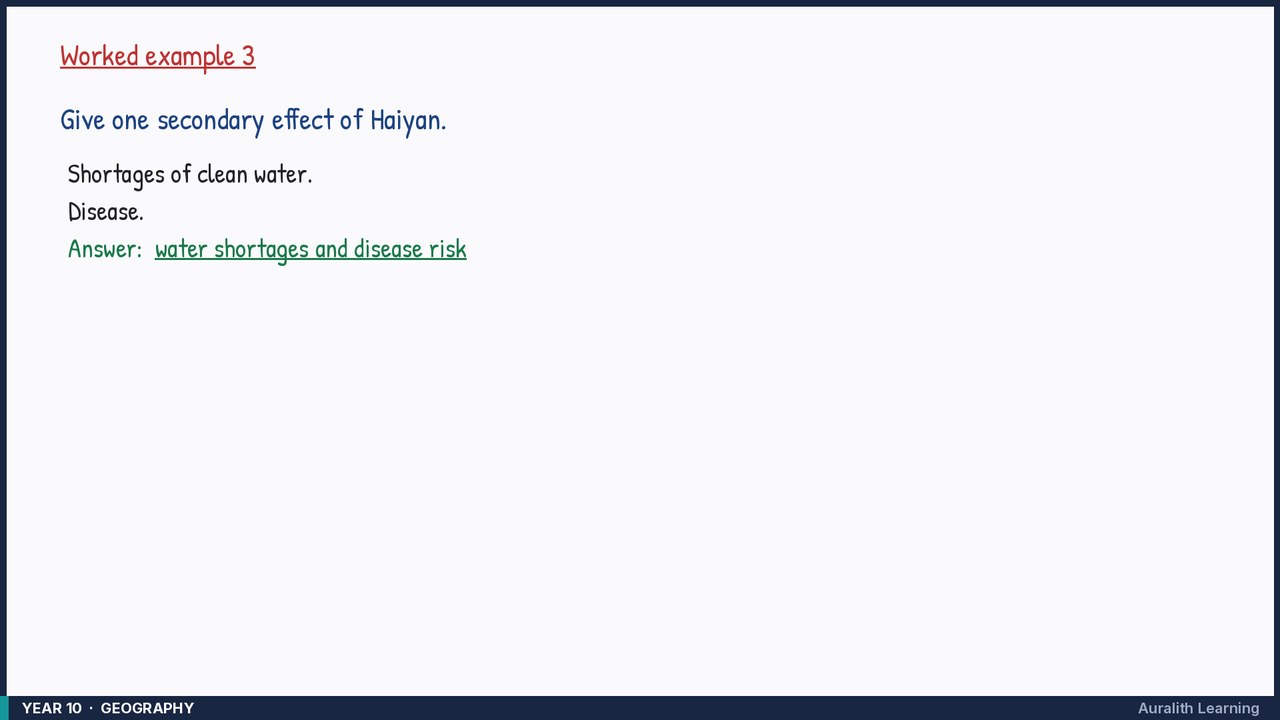
Question 3
Give one secondary effect of Haiyan.
- Step 1: Shortages of clean water.
- Step 2: Disease.
Answer: water shortages and disease risk