Year 10 (ages 14–15, Grade 9 in the US) · Geography · GCSE physical geography · Lesson 7
Managing climate change: mitigation and adaptation
The two ways to manage climate change: mitigation (reducing its causes) through renewable energy, carbon capture, planting trees and international agreements, and adaptation (responding to its effects) through flood defences, drought-resistant crops and water management.
Exam boards: this lesson matches the AQA GCSE geography courses. Check which course your school follows.
8-minute video lesson
Teaching, worked examples and 20 practice questions solved step by step.
Watch free for a monthWhat your child will learn
- Define mitigation and adaptation
- Describe mitigation strategies
- Describe adaptation strategies
- Evaluate the strategies
The method
- Mitigation: tackle the causes.
- Adaptation: cope with the effects.
- For each strategy: how it works.
- Evaluate: cost, scale, who benefits.
Key words: mitigation, adaptation, renewable energy, carbon capture, Paris Agreement.
Worked examples
Worked examples from the lesson, with every step.
Question 1
Is building a sea wall mitigation or adaptation?
- Step 1: Protects against rising seas.
- Step 2: Adaptation.
Answer: adaptation
Question 2
Is switching to wind power mitigation or adaptation?
- Step 1: Cuts CO₂ emissions.
- Step 2: Mitigation.
Answer: mitigation
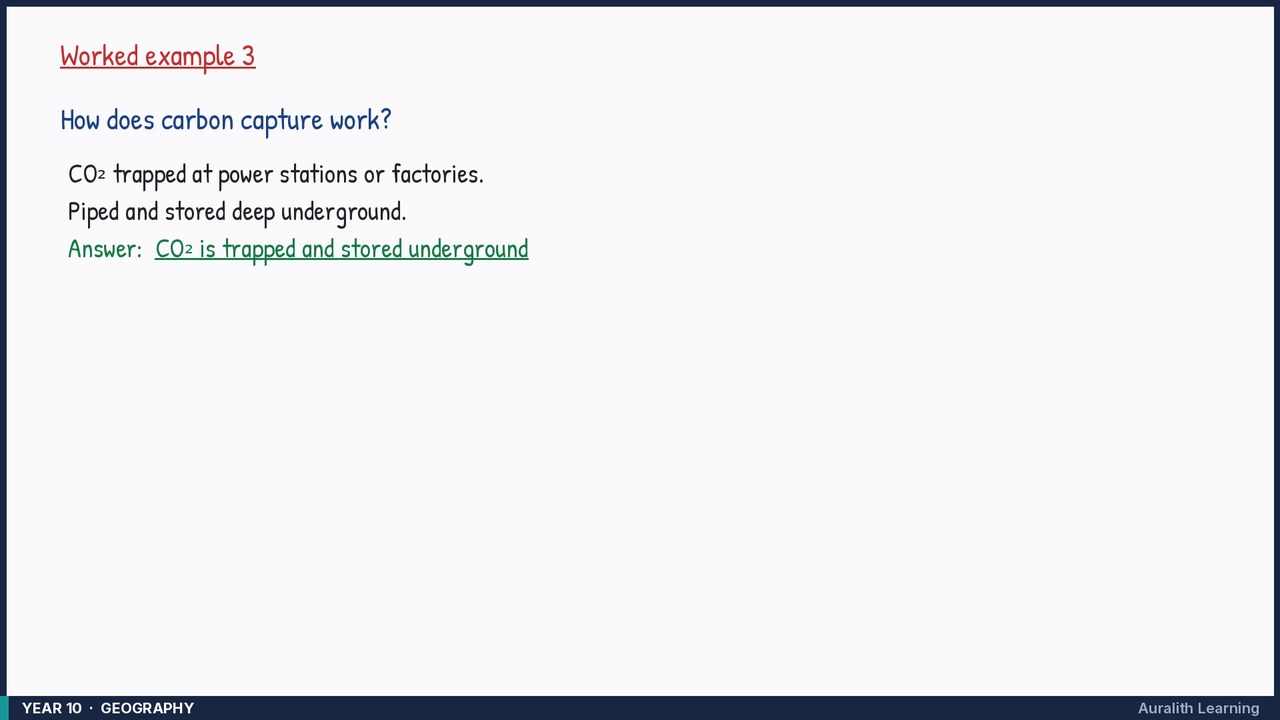
Question 3
How does carbon capture work?
- Step 1: CO₂ trapped at power stations or factories.
- Step 2: Piped and stored deep underground.
Answer: CO₂ is trapped and stored underground