Year 10 (ages 14–15, Grade 9 in the US) · Geography · GCSE physical geography · Lesson 11
Coastal processes and landforms
Weathering and mass movement at the coast, constructive and destructive waves, the processes of erosion, transportation (including longshore drift) and deposition, and the landforms they create: headlands and bays, caves, arches and stacks, beaches and spits.
Exam boards: this lesson matches the AQA GCSE geography courses. Check which course your school follows.
8-minute video lesson
Teaching, worked examples and 20 practice questions solved step by step.
Watch free for a monthWhat your child will learn
- Describe weathering and mass movement
- Explain the processes of erosion and transport
- Explain longshore drift
- Explain the formation of coastal landforms
The method
- Erosion: hydraulic action, abrasion, attrition, solution.
- Transport: traction, saltation, suspension, solution.
- Longshore drift moves sediment along the coast.
- Landforms: describe, then explain step by step.
Key words: hydraulic action, abrasion, longshore drift, wave-cut platform, spit.
Worked examples
Worked examples from the lesson, with every step.
Question 1
Explain hydraulic action.
- Step 1: Waves force water and air into cracks.
- Step 2: Pressure widens cracks; rock breaks.
Answer: the force of water and compressed air breaks rock
Question 2
Why do bays form in soft rock?
- Step 1: Soft rock erodes faster.
- Step 2: It's worn back into a bay.
Answer: soft rock erodes more quickly
Question 3
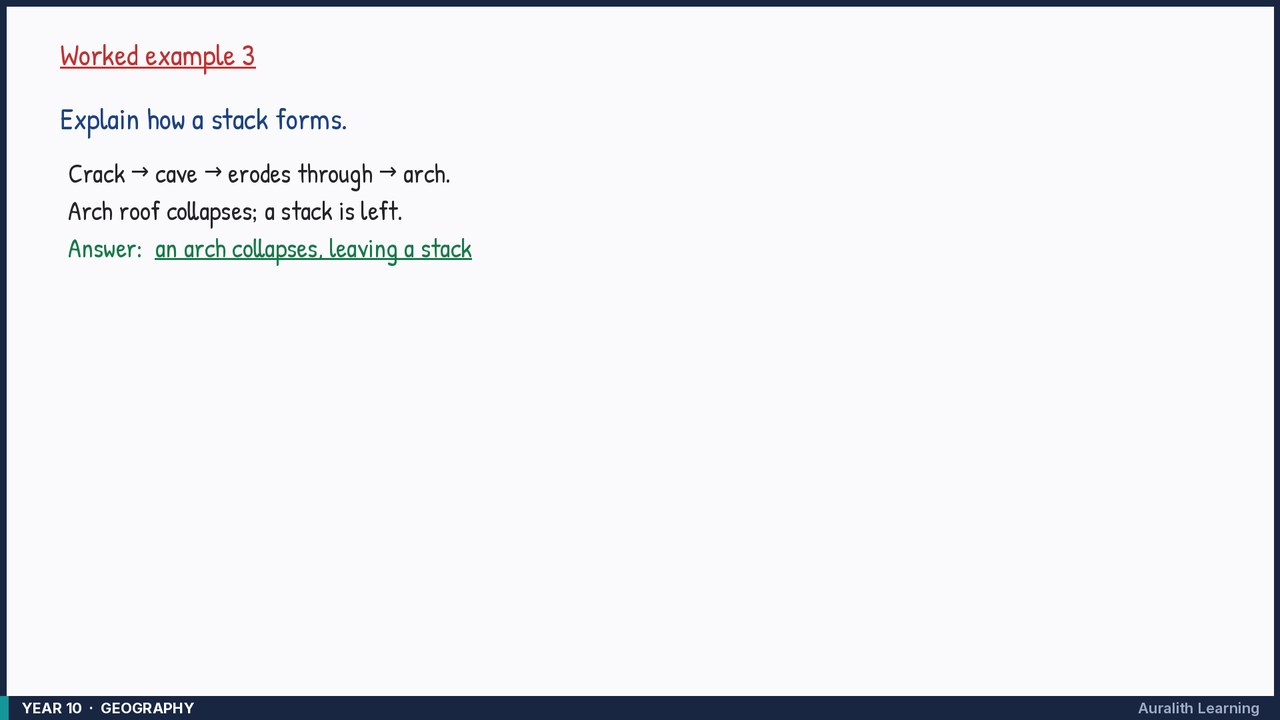
Explain how a stack forms.
- Step 1: Crack → cave → erodes through → arch.
- Step 2: Arch roof collapses; a stack is left.
Answer: an arch collapses, leaving a stack