Year 10 (ages 14–15, Grade 9 in the US) · Geography · GCSE physical geography · Lesson 4
Global atmospheric circulation and tropical storms
How the global atmospheric circulation model creates pressure belts and surface winds, how and where tropical storms form, their structure, and how climate change may affect them.
Exam boards: this lesson matches the AQA GCSE geography courses. Check which course your school follows.
8-minute video lesson
Teaching, worked examples and 20 practice questions solved step by step.
Watch free for a monthWhat your child will learn
- Describe the three circulation cells
- Explain high and low pressure belts
- Explain the conditions for tropical storm formation
- Describe the structure of a tropical storm
The method
- Warm air rises → low pressure; cool air sinks → high pressure.
- Three cells each side of the equator: Hadley, Ferrel, Polar.
- Storms need warm sea (27 °C+), 5–30° from the equator.
- Structure: eye, eyewall, rain bands.
Key words: Hadley cell, low pressure, Coriolis effect, eye, eyewall.
Worked examples
Worked examples from the lesson, with every step.
Question 1
Why is there low pressure at the equator?
- Step 1: Intense sun heats the ground and air.
- Step 2: Warm air rises → low pressure.
Answer: warm air rises
Question 2
Why are many hot deserts at about 30° latitude?
- Step 1: Air sinks at the edge of the Hadley cell.
- Step 2: High pressure: dry, cloudless.
Answer: sinking air creates dry high pressure
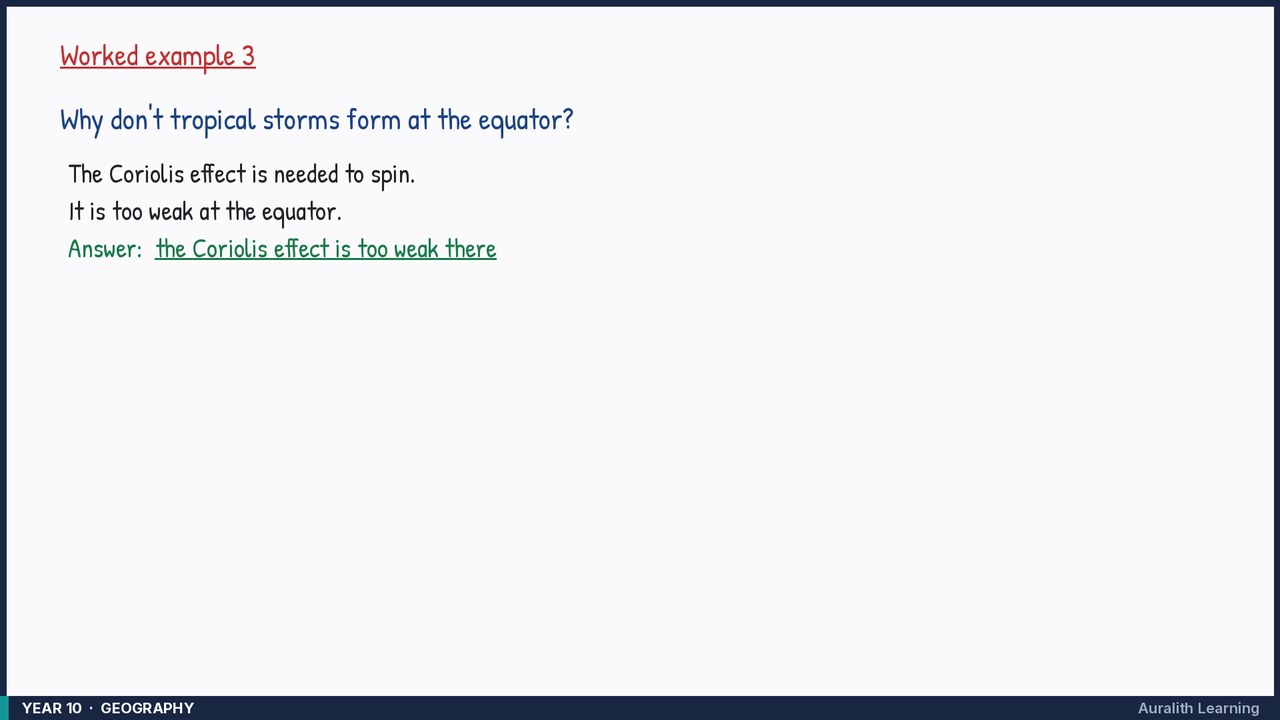
Question 3
Why don't tropical storms form at the equator?
- Step 1: The Coriolis effect is needed to spin.
- Step 2: It is too weak at the equator.
Answer: the Coriolis effect is too weak there