Year 10 (ages 14–15, Grade 9 in the US) · Geography · GCSE physical geography · Lesson 13
River processes and landforms
How a river's long and cross profiles change downstream, the processes of erosion, transport and deposition, and how waterfalls, gorges, interlocking spurs, meanders, ox-bow lakes, levees and floodplains form.
Exam boards: this lesson matches the AQA GCSE geography courses. Check which course your school follows.
8-minute video lesson
Teaching, worked examples and 20 practice questions solved step by step.
Watch free for a monthWhat your child will learn
- Describe the long and cross profiles
- Explain river processes
- Explain upper course landforms
- Explain middle and lower course landforms
The method
- Upper course: steep, narrow, vertical erosion.
- Middle course: meanders, lateral erosion.
- Lower course: wide, flat, deposition.
- Explain landforms step by step with processes.
Key words: vertical erosion, lateral erosion, meander, ox-bow lake, levee.
Worked examples
Worked examples from the lesson, with every step.
Question 1
Why is the upper course V-shaped?
- Step 1: Vertical erosion cuts down.
- Step 2: Weathering and mass movement wear the sides.
Answer: vertical erosion plus weathering of the sides
Question 2
Explain how a waterfall retreats.
- Step 1: Soft rock erodes; hard rock overhangs.
- Step 2: Overhang collapses; waterfall moves upstream.
Answer: undercutting and collapse move it upstream
Question 3
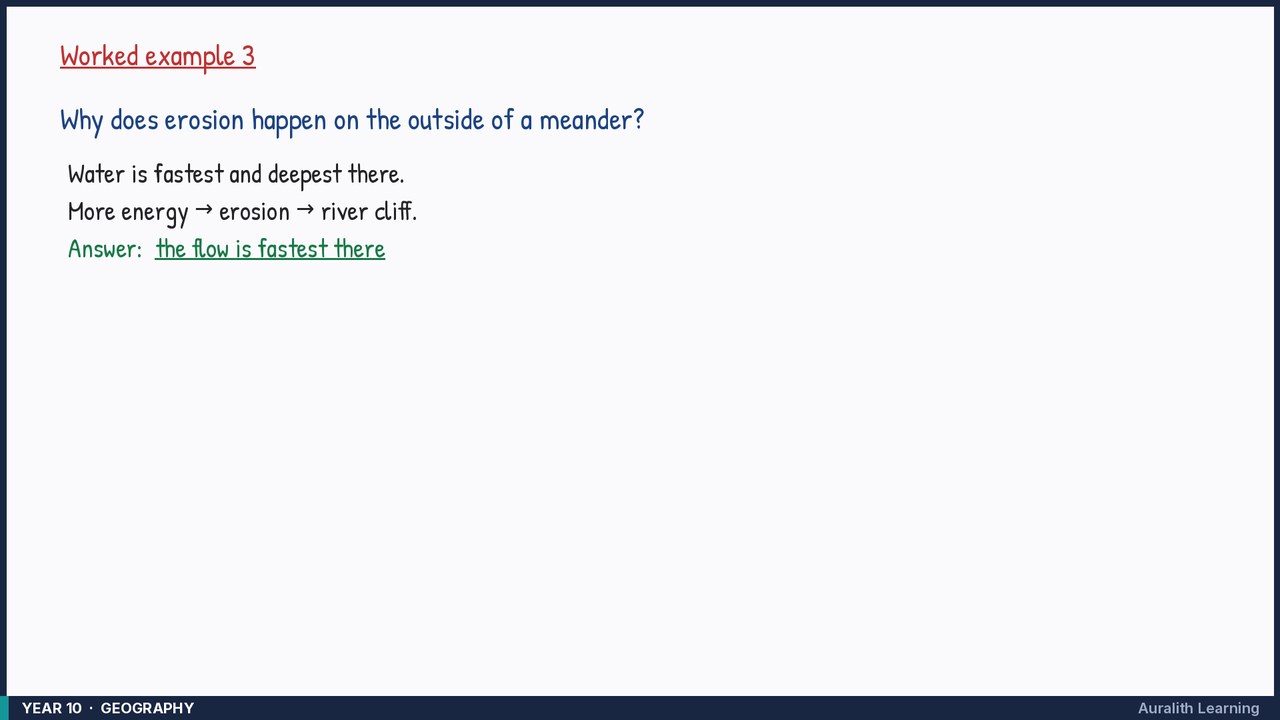
Why does erosion happen on the outside of a meander?
- Step 1: Water is fastest and deepest there.
- Step 2: More energy → erosion → river cliff.
Answer: the flow is fastest there