Year 10 (ages 14–15, Grade 9 in the US) · Geography · GCSE physical geography · Lesson 1
Natural hazards and plate tectonics
What natural hazards are and what affects hazard risk, the structure of the Earth, why plates move, and what happens at destructive, constructive and conservative plate margins.
Exam boards: this lesson matches the AQA GCSE geography courses. Check which course your school follows.
8-minute video lesson
Teaching, worked examples and 20 practice questions solved step by step.
Watch free for a monthWhat your child will learn
- Define a natural hazard and hazard risk
- Describe the structure of the Earth
- Explain why plates move
- Describe the three types of plate margin
The method
- Hazard = natural event that threatens people or property.
- Risk rises with vulnerability and exposure.
- Plates move on the mantle (convection and slab pull).
- Margins: destructive, constructive, conservative.
Key words: natural hazard, hazard risk, plate margin, convection current, subduction.
Worked examples
Worked examples from the lesson, with every step.
Question 1
Define hazard risk.
- Step 1: The probability of being affected by a hazard.
- Step 2: Vulnerability and exposure.
Answer: the chance of being affected by a hazard
Question 2
Why does oceanic crust sink at a destructive margin?
- Step 1: Oceanic is denser than continental.
- Step 2: It is subducted into the mantle.
Answer: it is denser
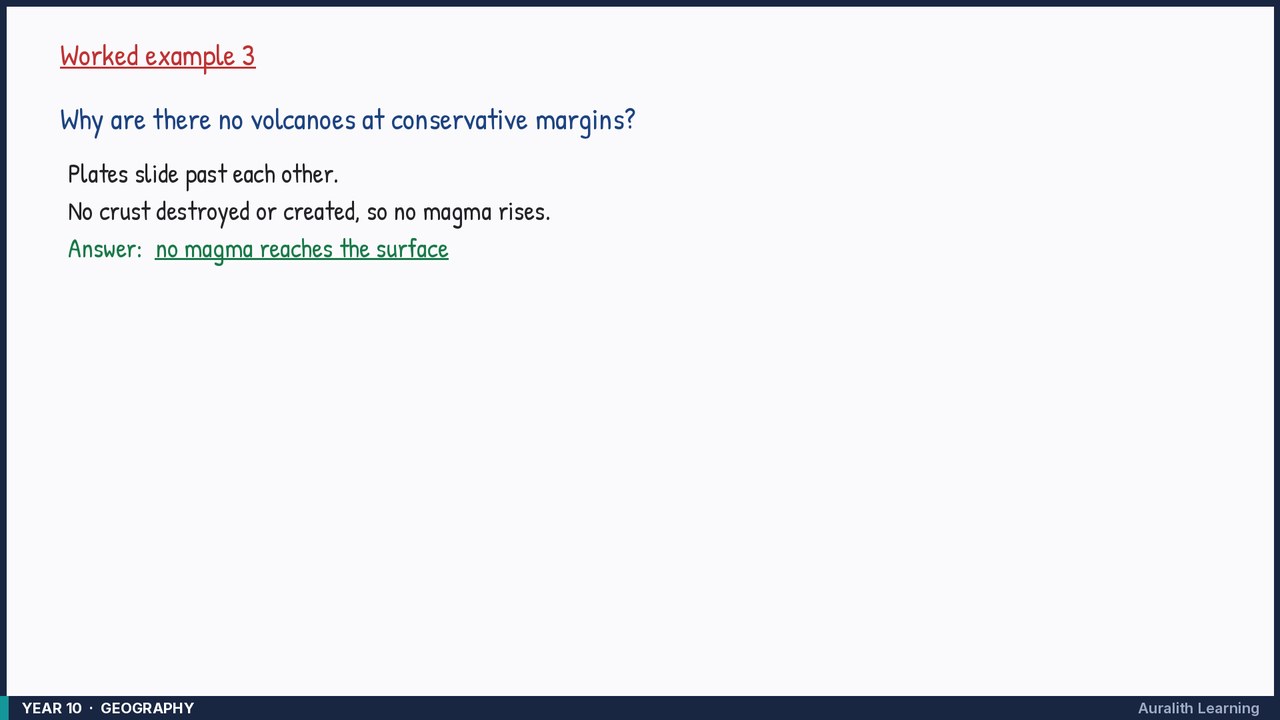
Question 3
Why are there no volcanoes at conservative margins?
- Step 1: Plates slide past each other.
- Step 2: No crust destroyed or created, so no magma rises.
Answer: no magma reaches the surface