Year 10 (ages 14–15, Grade 9 in the US) · Geography · GCSE physical geography · Lesson 2
Earthquakes: effects and responses
Primary and secondary effects of earthquakes, immediate and long-term responses, and a comparison of two earthquakes in places at different levels of development: Chile 2010 and Nepal 2015.
Exam boards: this lesson matches the AQA GCSE geography courses. Check which course your school follows.
8-minute video lesson
Teaching, worked examples and 20 practice questions solved step by step.
Watch free for a monthWhat your child will learn
- Distinguish primary and secondary effects
- Distinguish immediate and long-term responses
- Compare Chile 2010 and Nepal 2015
- Explain why effects differ with development
The method
- Primary: caused directly by the shaking.
- Secondary: result from primary effects.
- Immediate: hours to weeks. Long-term: months to years.
- Compare using development: wealth, buildings, preparation.
Key words: primary effect, secondary effect, immediate response, long-term response, magnitude.
Worked examples
Worked examples from the lesson, with every step.
Question 1
Is a tsunami a primary or secondary effect?
- Step 1: Caused by the sea floor moving in the earthquake.
- Step 2: It follows on from the shaking: secondary.
Answer: secondary
Question 2
Is search and rescue an immediate or long-term response?
- Step 1: Hours to days after.
- Step 2: Immediate.
Answer: immediate
Question 3
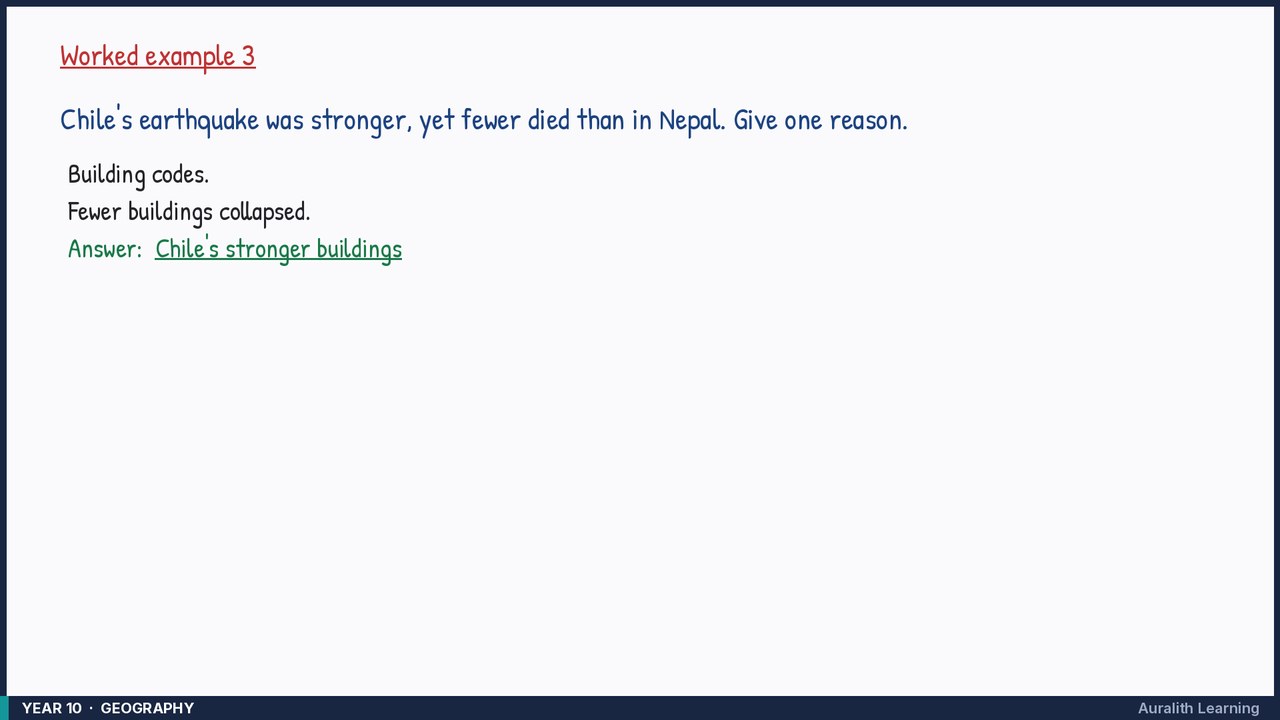
Chile's earthquake was stronger, yet fewer died than in Nepal. Give one reason.
- Step 1: Building codes.
- Step 2: Fewer buildings collapsed.
Answer: Chile's stronger buildings