Year 10 (ages 14–15, Grade 9 in the US) · Geography · GCSE physical geography · Lesson 12
Coastal management
Hard engineering (sea walls, groynes, rock armour, gabions), soft engineering (beach nourishment, dune regeneration) and managed retreat, with the Holderness coast as an example of a rapidly eroding coastline.
Exam boards: this lesson matches the AQA GCSE geography courses. Check which course your school follows.
8-minute video lesson
Teaching, worked examples and 20 practice questions solved step by step.
Watch free for a monthWhat your child will learn
- Describe hard engineering methods
- Describe soft engineering methods
- Explain managed retreat
- Evaluate coastal management, using Holderness
The method
- For each method: what it is and how it works.
- Advantages and disadvantages, including cost.
- Consider knock-on effects further along the coast.
- Judge: what suits this place?
Key words: hard engineering, soft engineering, groyne, beach nourishment, managed retreat.
Worked examples
Worked examples from the lesson, with every step.
Question 1
Explain how groynes work.
- Step 1: They stop sand moving along by longshore drift.
- Step 2: A wider beach absorbs wave energy.
Answer: they trap sand to build a protective beach
Question 2
Give one disadvantage of a sea wall.
- Step 1: Very expensive to build and maintain.
- Step 2: Can look unattractive; waves may scour the base.
Answer: very expensive
Question 3
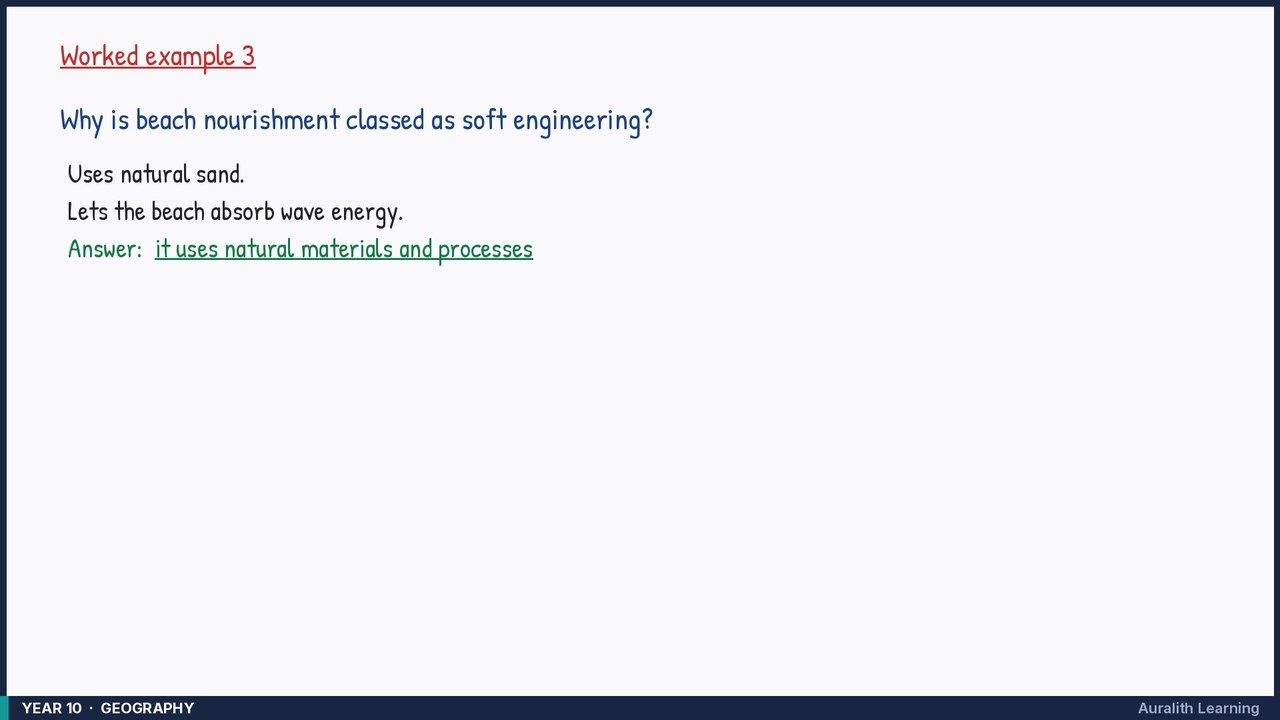
Why is beach nourishment classed as soft engineering?
- Step 1: Uses natural sand.
- Step 2: Lets the beach absorb wave energy.
Answer: it uses natural materials and processes