Year 10 (ages 14–15, Grade 9 in the US) · Geography · GCSE physical geography · Lesson 8
Ecosystems and global biomes
What an ecosystem is, producers, consumers and decomposers, food chains and webs, nutrient cycling, how change to one part affects the whole, and the distribution of the world's major biomes.
Exam boards: this lesson matches the AQA GCSE geography courses. Check which course your school follows.
8-minute video lesson
Teaching, worked examples and 20 practice questions solved step by step.
Watch free for a monthWhat your child will learn
- Define an ecosystem
- Explain food chains, food webs and nutrient cycling
- Explain the impact of change
- Describe the distribution of global biomes
The method
- Ecosystem = living (biotic) + non-living (abiotic) parts.
- Energy flows: producer → consumers.
- Decomposers return nutrients to the soil.
- Biomes follow climate, linked to latitude.
Key words: ecosystem, producer, decomposer, nutrient cycling, biome.
Worked examples
Worked examples from the lesson, with every step.
Question 1
Is sunlight biotic or abiotic?
- Step 1: Sunlight is not alive.
- Step 2: Abiotic.
Answer: abiotic
Question 2
Build a simple food chain for a pond.
- Step 1: Pondweed.
- Step 2: pondweed → snail → fish → heron
Answer: pondweed → snail → fish → heron
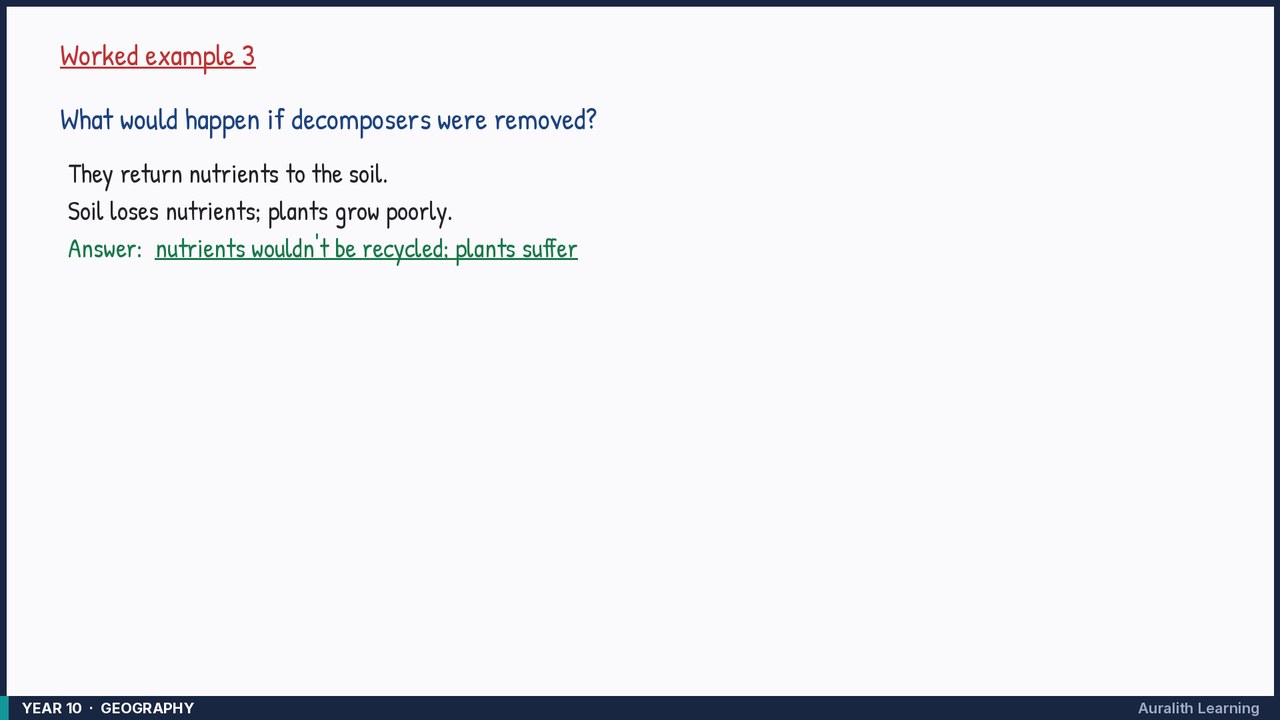
Question 3
What would happen if decomposers were removed?
- Step 1: They return nutrients to the soil.
- Step 2: Soil loses nutrients; plants grow poorly.
Answer: nutrients wouldn't be recycled; plants suffer