Year 10 (ages 14–15, Grade 9 in the US) · History · GCSE thematic study and historic environment · Lesson 10
The Western Front: the chain of evacuation
How wounded soldiers were moved from the front line to hospitals: stretcher bearers, Regimental Aid Posts, Dressing Stations, Casualty Clearing Stations and Base Hospitals, plus the RAMC, FANY, triage and transport.
Exam boards: this lesson matches the Pearson Edexcel GCSE history courses. Check which course your school follows.
9-minute video lesson
Teaching, worked examples and 20 practice questions solved step by step.
Watch free for a monthWhat your child will learn
- Describe each stage of the chain of evacuation
- Explain the role of the RAMC and FANY
- Explain triage
- Explain the difficulties of moving the wounded
The method
- Learn the chain in order, front to back.
- For each stage: where, who, what treatment.
- Triage: sorting patients by urgency.
- Problems: mud, shelling, distance, numbers.
Key words: Regimental Aid Post, Dressing Station, Casualty Clearing Station, Base Hospital, triage.
Worked examples
Worked examples from the lesson, with every step.
Question 1
Describe one feature of a Casualty Clearing Station. (2 marks)
- Step 1: Main surgery took place there.
- Step 2: Further from the front; triage used.
Answer: the main surgery centre, further back, using triage
Question 2
Put in order: Base Hospital, RAP, CCS, Dressing Station.
- Step 1: RAP is nearest the front.
- Step 2: RAP → Dressing Station → CCS → Base Hospital
Answer: RAP, Dressing Station, CCS, Base Hospital
Question 3
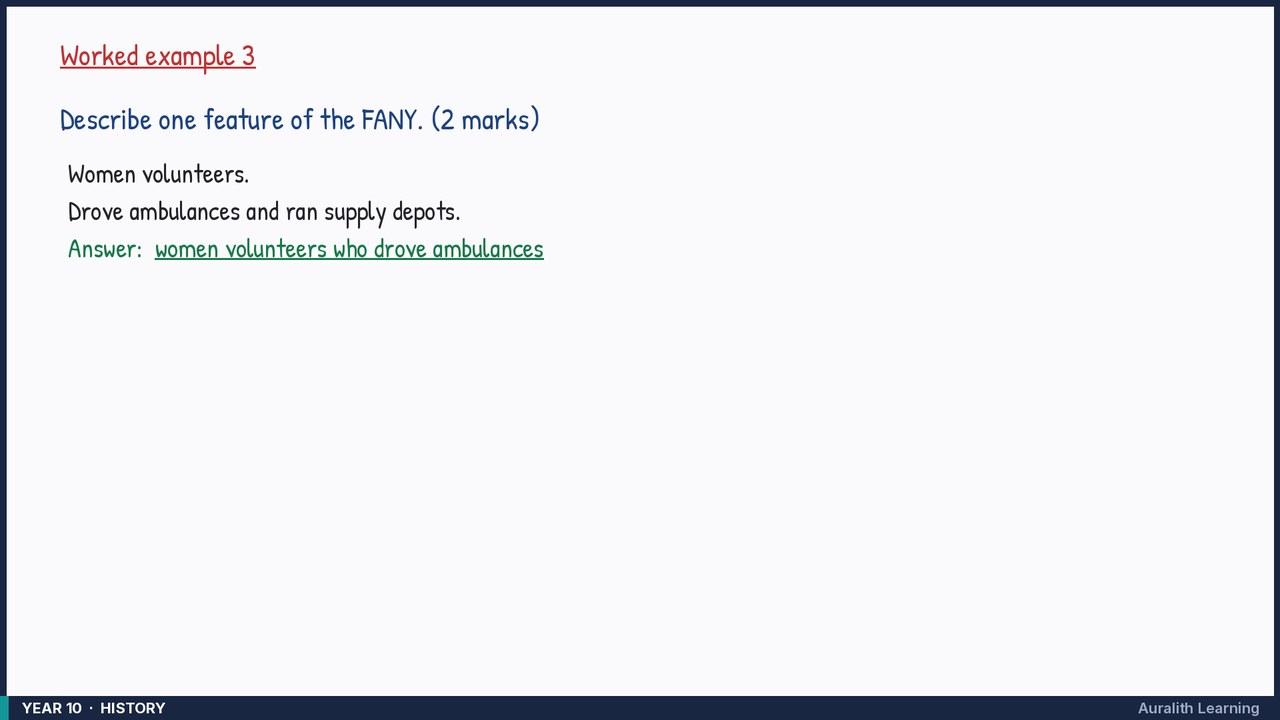
Describe one feature of the FANY. (2 marks)
- Step 1: Women volunteers.
- Step 2: Drove ambulances and ran supply depots.
Answer: women volunteers who drove ambulances