Year 10 (ages 14–15, Grade 9 in the US) · History · GCSE thematic study and historic environment · Lesson 3
Renaissance medicine: new ideas, c1500–c1700
How the Renaissance challenged old ideas: Vesalius's anatomy, Harvey's discovery of the circulation of the blood, Sydenham's focus on observation, and the roles of the printing press and the Royal Society.
Exam boards: this lesson matches the AQA and Pearson Edexcel GCSE history courses. Check which course your school follows.
9-minute video lesson
Teaching, worked examples and 20 practice questions solved step by step.
Watch free for a monthWhat your child will learn
- Explain why the Renaissance encouraged new ideas
- Describe the work of Vesalius and Harvey
- Describe Sydenham's approach
- Explain the role of printing and the Royal Society
The method
- New attitude: question old authorities.
- Individuals: Vesalius (anatomy), Harvey (blood), Sydenham (observation).
- Technology: printing spread ideas quickly.
- But: treatment of ordinary people changed little.
Key words: Renaissance, dissection, circulation, printing press, Royal Society.
Worked examples
Worked examples from the lesson, with every step.
Question 1
Describe one feature of Vesalius's work. (2 marks)
- Step 1: Human dissection.
- Step 2: Published accurate drawings in 1543.
Answer: he dissected humans and published accurate anatomy drawings in 1543
Question 2
Why did Galen make anatomical mistakes?
- Step 1: He dissected animals.
- Step 2: Assumed humans were the same.
Answer: he dissected animals, not humans
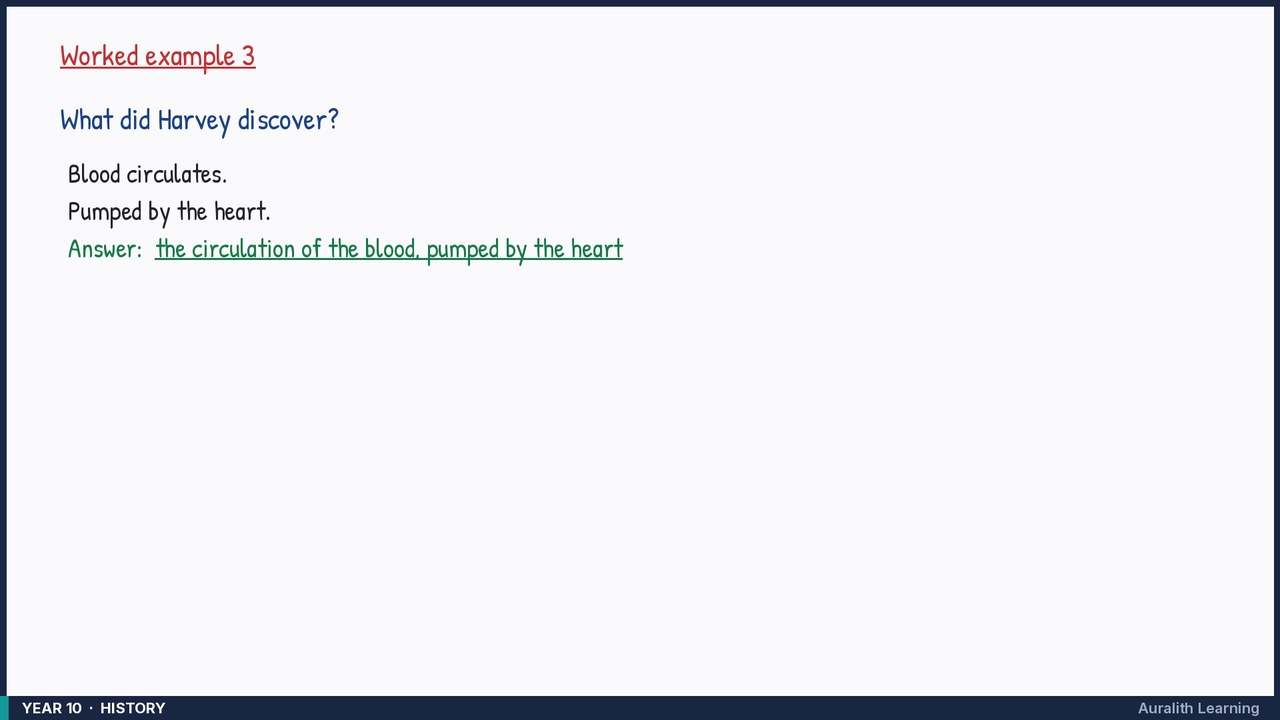
Question 3
What did Harvey discover?
- Step 1: Blood circulates.
- Step 2: Pumped by the heart.
Answer: the circulation of the blood, pumped by the heart