Year 10 (ages 14–15, Grade 9 in the US) · History · GCSE thematic study and historic environment · Lesson 1
Medieval ideas about the causes of disease, c1250–c1500
Why medieval people believed illness came from God, the Four Humours, miasma and the stars, and how the Church and the ideas of Hippocrates and Galen shaped medicine for centuries.
Exam boards: this lesson matches the AQA and Pearson Edexcel GCSE history courses. Check which course your school follows.
9-minute video lesson
Teaching, worked examples and 20 practice questions solved step by step.
Watch free for a monthWhat your child will learn
- Describe supernatural and religious explanations
- Explain the Theory of the Four Humours
- Explain miasma
- Explain why ideas changed so little
The method
- Supernatural: God's punishment, or the stars.
- Rational: the Four Humours, and miasma (bad air).
- Galen's ideas were trusted for over 1000 years.
- The Church controlled learning and supported Galen.
Key words: Four Humours, miasma, Galen, Hippocrates, Church.
Worked examples
Worked examples from the lesson, with every step.
Question 1
Describe one feature of the Theory of the Four Humours. (2 marks)
- Step 1: The body had four humours.
- Step 2: Blood, phlegm, yellow bile, black bile; imbalance caused illness.
Answer: illness was thought to be caused by an imbalance of four humours
Question 2
Why would a medieval physician bleed a patient with a fever?
- Step 1: Fever = too much blood.
- Step 2: Remove blood to restore balance.
Answer: to rebalance the humours by removing excess blood
Question 3
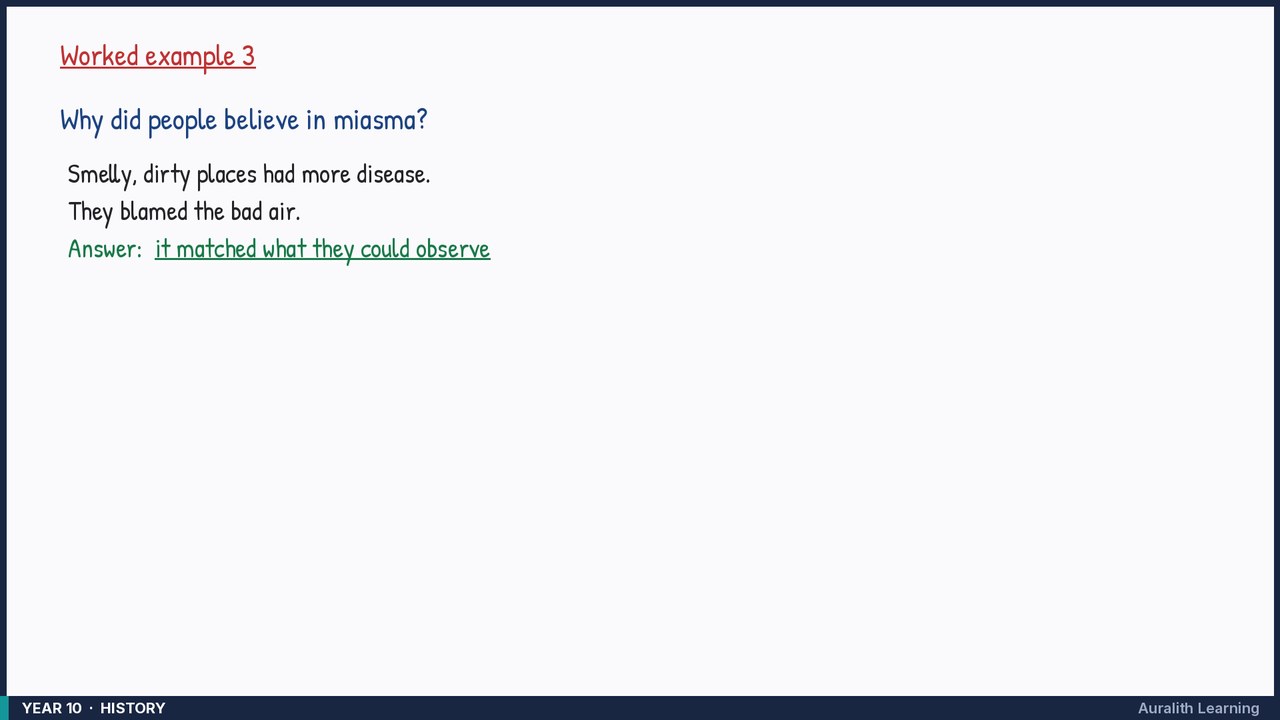
Why did people believe in miasma?
- Step 1: Smelly, dirty places had more disease.
- Step 2: They blamed the bad air.
Answer: it matched what they could observe