Year 10 (ages 14–15, Grade 9 in the US) · History · GCSE thematic study and historic environment · Lesson 6
Surgery, hospitals and public health, c1800–c1900
How anaesthetics and antiseptics transformed surgery, Florence Nightingale's impact on hospitals and nursing, John Snow and the 1854 cholera outbreak, and the Public Health Act of 1875.
Exam boards: this lesson matches the AQA and Pearson Edexcel GCSE history courses. Check which course your school follows.
10-minute video lesson
Teaching, worked examples and 20 practice questions solved step by step.
Watch free for a monthWhat your child will learn
- Explain how anaesthetics and antiseptics changed surgery
- Describe Nightingale's impact on hospitals
- Explain Snow's work on cholera
- Explain why the 1875 Public Health Act happened
The method
- Surgery's problems: pain, infection, blood loss.
- Simpson (chloroform, 1847) and Lister (carbolic acid, 1867).
- Snow linked cholera to a water pump in 1854.
- Government took more responsibility: 1875 Act.
Key words: anaesthetic, antiseptic, chloroform, carbolic acid, Public Health Act.
Worked examples
Worked examples from the lesson, with every step.
Question 1
Describe one feature of Lister's work. (2 marks)
- Step 1: Used carbolic acid as an antiseptic.
- Step 2: From 1867, on wounds and instruments, inspired by germ theory.
Answer: he used carbolic acid from 1867 to kill germs during surgery
Question 2
Explain why some surgeons opposed anaesthetics at first.
- Step 1: Hard to get the dose right; some deaths.
- Step 2: Some thought pain was natural or God's will.
Answer: safety worries and beliefs about pain
Question 3
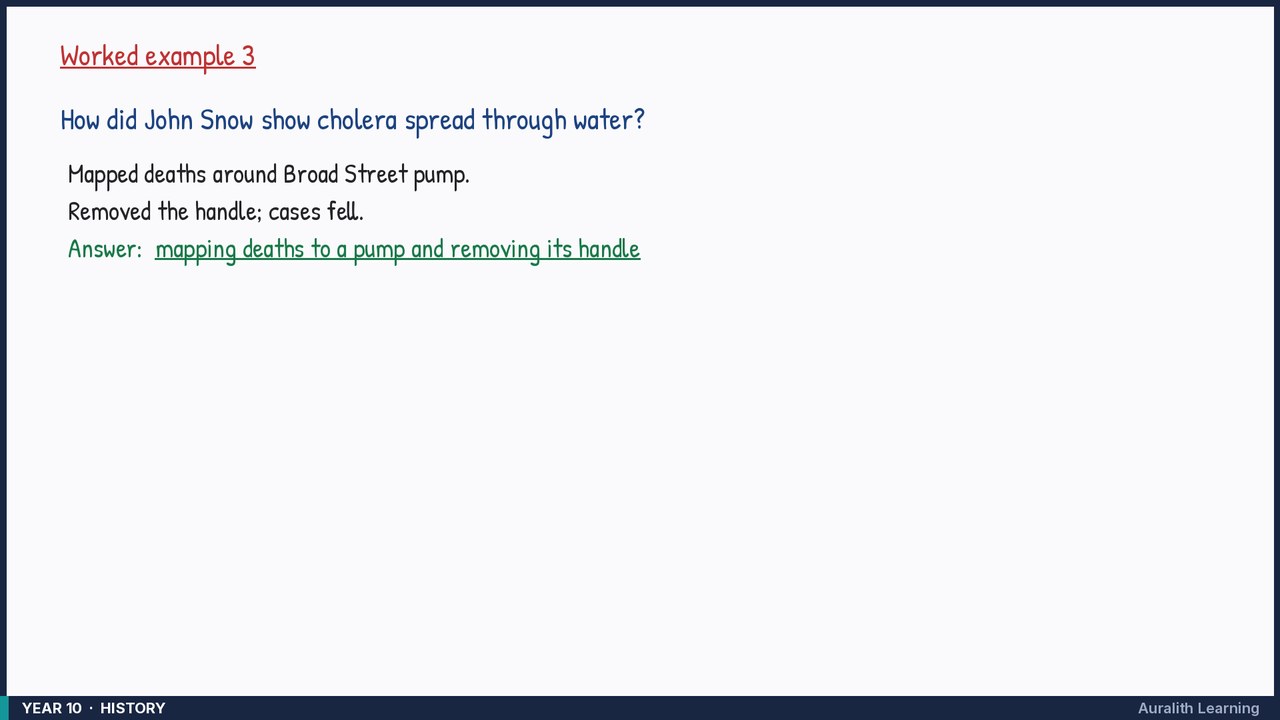
How did John Snow show cholera spread through water?
- Step 1: Mapped deaths around Broad Street pump.
- Step 2: Removed the handle; cases fell.
Answer: mapping deaths to a pump and removing its handle