Year 10 (ages 14–15, Grade 9 in the US) · History · GCSE thematic study and historic environment · Lesson 5
Jenner, Pasteur and germ theory, c1700–c1900
Edward Jenner's smallpox vaccination and the opposition to it, Louis Pasteur's germ theory of 1861, Robert Koch's work identifying specific bacteria, and why germ theory was a turning point.
Exam boards: this lesson matches the AQA and Pearson Edexcel GCSE history courses. Check which course your school follows.
9-minute video lesson
Teaching, worked examples and 20 practice questions solved step by step.
Watch free for a monthWhat your child will learn
- Explain how Jenner developed vaccination
- Explain opposition to vaccination
- Describe Pasteur's germ theory
- Explain the importance of Koch's work
The method
- Jenner (1796): observation and experiment, but no explanation of why it worked.
- Pasteur (1861): germs in the air cause decay and disease.
- Koch: identified the bacteria causing specific diseases.
- Germ theory replaced miasma — slowly.
Key words: vaccination, smallpox, germ theory, spontaneous generation, bacteria.
Worked examples
Worked examples from the lesson, with every step.
Question 1
Describe one feature of Jenner's work on smallpox. (2 marks)
- Step 1: Used cowpox to protect against smallpox.
- Step 2: Tested on a boy in 1796.
Answer: he used cowpox to protect against smallpox, testing it in 1796
Question 2
Why did some people oppose vaccination?
- Step 1: Jenner couldn't explain it.
- Step 2: Compulsory vaccination angered some.
Answer: no explanation, and resentment of compulsion
Question 3
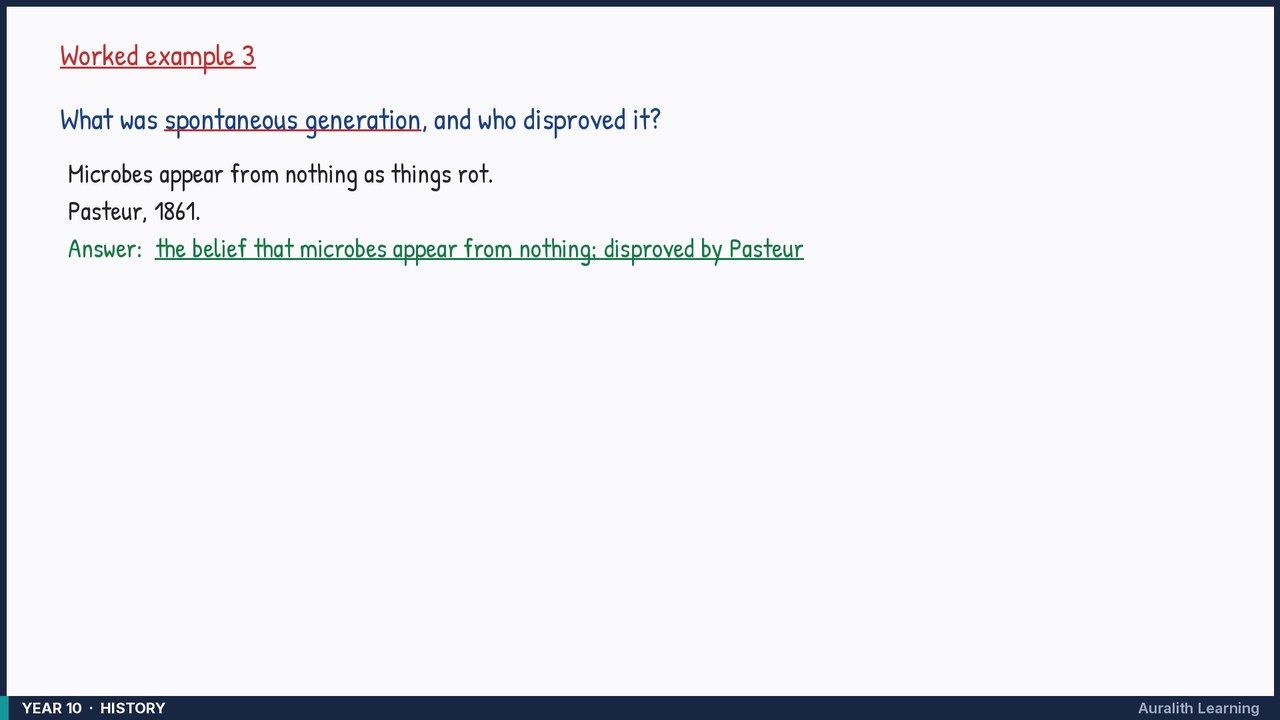
What was spontaneous generation, and who disproved it?
- Step 1: Microbes appear from nothing as things rot.
- Step 2: Pasteur, 1861.
Answer: the belief that microbes appear from nothing; disproved by Pasteur