Year 10 (ages 14–15, Grade 9 in the US) · History · GCSE thematic study and historic environment · Lesson 8
Magic bullets, penicillin and lung cancer
The first chemical cures (magic bullets), the discovery and development of penicillin by Fleming, Florey and Chain, and how lung cancer is diagnosed, treated and prevented today.
Exam boards: this lesson matches the AQA and Pearson Edexcel GCSE history courses. Check which course your school follows.
9-minute video lesson
Teaching, worked examples and 20 practice questions solved step by step.
Watch free for a monthWhat your child will learn
- Explain what magic bullets were
- Describe the discovery and development of penicillin
- Explain the factors behind penicillin's mass production
- Describe modern approaches to lung cancer
The method
- Ehrlich's Salvarsan 606 (1909): first magic bullet.
- Fleming noticed penicillin in 1928.
- Florey and Chain developed it from 1938–1940s.
- War and government funding enabled mass production.
Key words: magic bullet, Salvarsan 606, penicillin, mass production, lung cancer.
Worked examples
Worked examples from the lesson, with every step.
Question 1
Describe one feature of Salvarsan 606. (2 marks)
- Step 1: The first magic bullet.
- Step 2: Found by Ehrlich's team in 1909; treated syphilis.
Answer: the first magic bullet, found by Ehrlich's team in 1909
Question 2
Why couldn't Fleming develop penicillin himself?
- Step 1: Couldn't produce enough pure penicillin.
- Step 2: Lacked funding and support.
Answer: he couldn't make enough pure penicillin to test
Question 3
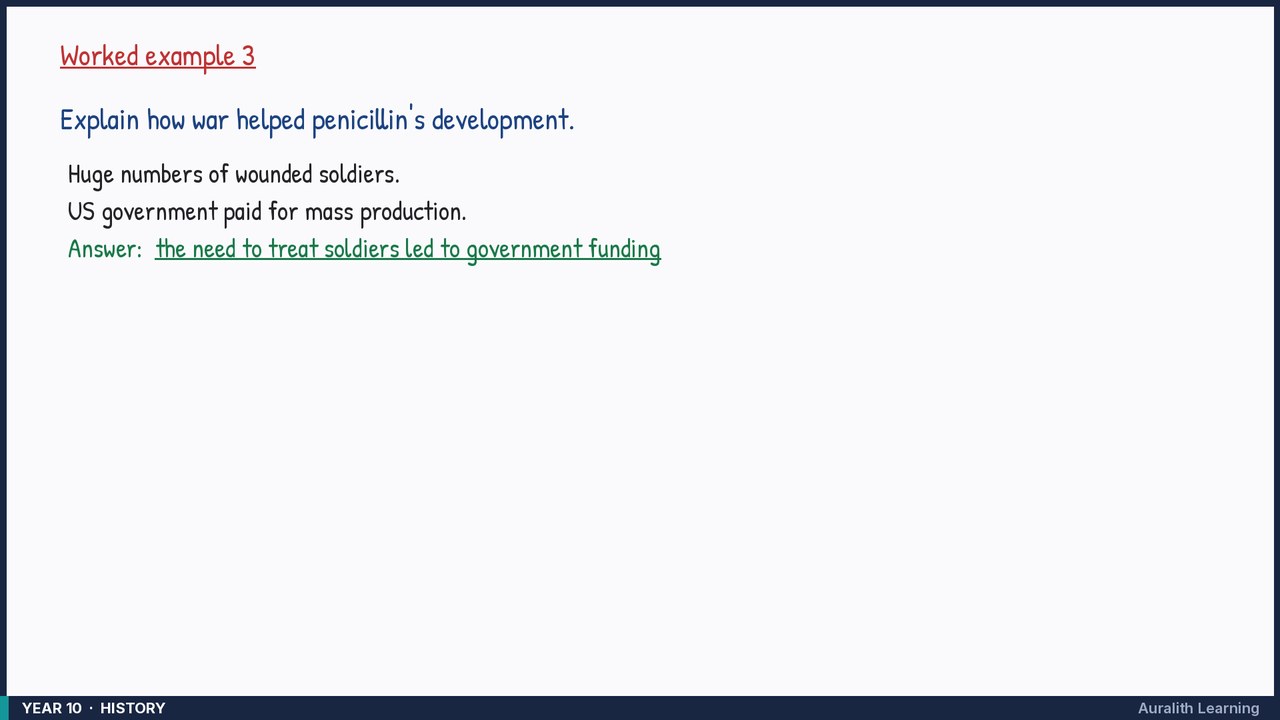
Explain how war helped penicillin's development.
- Step 1: Huge numbers of wounded soldiers.
- Step 2: US government paid for mass production.
Answer: the need to treat soldiers led to government funding