Year 11 (ages 15–16, Grade 10 in the US) · History · GCSE modern depth study · Lesson 3
Weimar recovery under Stresemann, 1924–1929
How Gustav Stresemann helped Germany recover after 1923 — the Rentenmark, the Dawes and Young Plans, the Locarno Pact and League membership — cultural change in the ‘golden years’, and how far the recovery was secure.
Exam boards: this lesson matches the AQA and Pearson Edexcel GCSE history courses. Check which course your school follows.
8-minute video lesson
Teaching, worked examples and 20 practice questions solved step by step.
Watch free for a monthWhat your child will learn
- Describe Stresemann's economic policies
- Describe his foreign policy successes
- Describe cultural change in the Weimar years
- Evaluate how secure the recovery was
The method
- Rentenmark (1923) ended hyperinflation.
- Dawes Plan (1924): US loans; reparations rescheduled.
- Locarno (1925), League of Nations (1926), Kellogg–Briand (1928).
- Recovery depended heavily on American loans.
Key words: Rentenmark, Dawes Plan, Young Plan, Locarno Pact, League of Nations.
Worked examples
Worked examples from the lesson, with every step.
Question 1
How did the Rentenmark help Germany?
- Step 1: The old mark was worthless.
- Step 2: A new, stable currency restored confidence.
Answer: it ended hyperinflation
Question 2
What did the Dawes Plan do?
- Step 1: Rescheduled payments.
- Step 2: US loans to Germany.
Answer: rescheduled reparations and brought US loans
Question 3
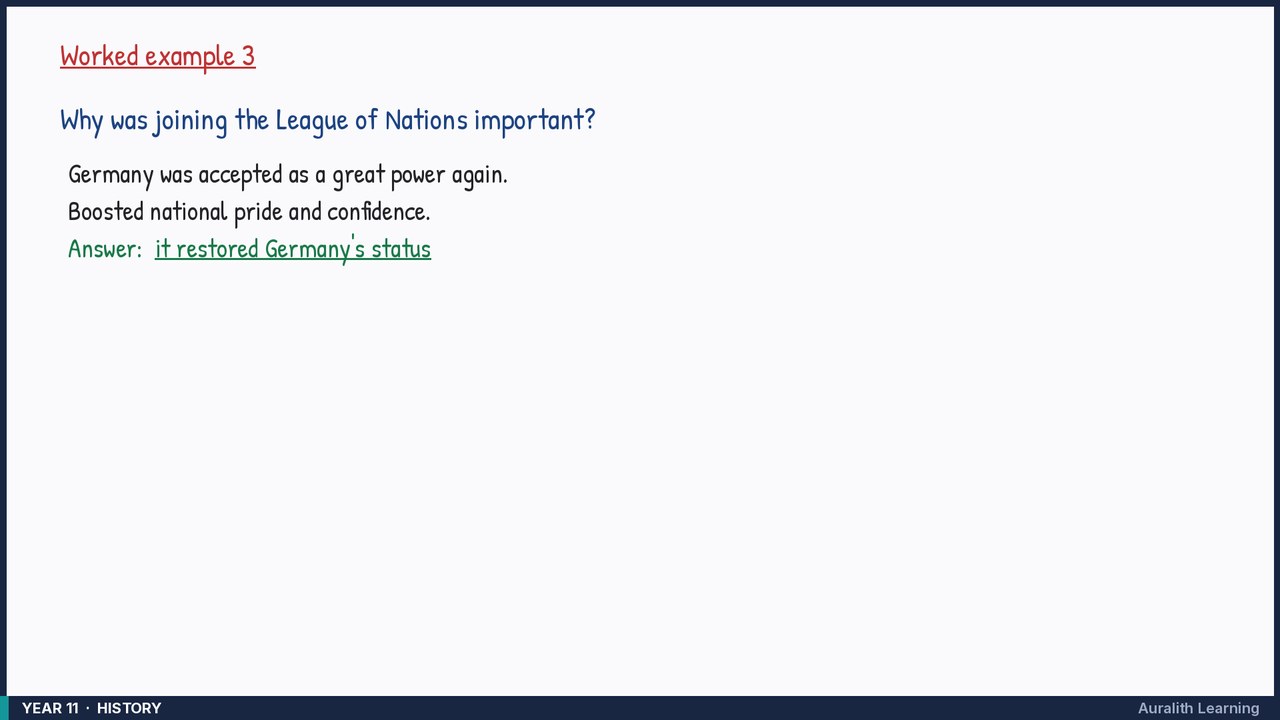
Why was joining the League of Nations important?
- Step 1: Germany was accepted as a great power again.
- Step 2: Boosted national pride and confidence.
Answer: it restored Germany's status