Year 11 (ages 15–16, Grade 10 in the US) · History · GCSE modern depth study · Lesson 2
Challenges to Weimar, 1919–1923
The political and economic crises facing the Weimar Republic from 1919 to 1923: the Spartacist Revolt, the Kapp Putsch, the occupation of the Ruhr, hyperinflation, and Hitler's Munich Putsch.
Exam boards: this lesson matches the AQA and Pearson Edexcel GCSE history courses. Check which course your school follows.
8-minute video lesson
Teaching, worked examples and 20 practice questions solved step by step.
Watch free for a monthWhat your child will learn
- Describe threats from the left and right
- Explain the causes of hyperinflation
- Describe the effects of hyperinflation
- Explain the Munich Putsch and its consequences
The method
- Left: Spartacist Revolt, January 1919.
- Right: Kapp Putsch, March 1920.
- 1923: Ruhr occupied → hyperinflation.
- November 1923: Munich Putsch fails; Hitler jailed.
Key words: Spartacist, putsch, Ruhr, hyperinflation, Freikorps.
Worked examples
Worked examples from the lesson, with every step.
Question 1
Who were the Spartacists, and what happened to their revolt?
- Step 1: German communists.
- Step 2: Crushed by the Freikorps in January 1919.
Answer: communists crushed by the Freikorps
Question 2
Why did the Kapp Putsch fail?
- Step 1: Workers held a general strike.
- Step 2: Berlin couldn't function, so Kapp gave up.
Answer: a general strike
Question 3
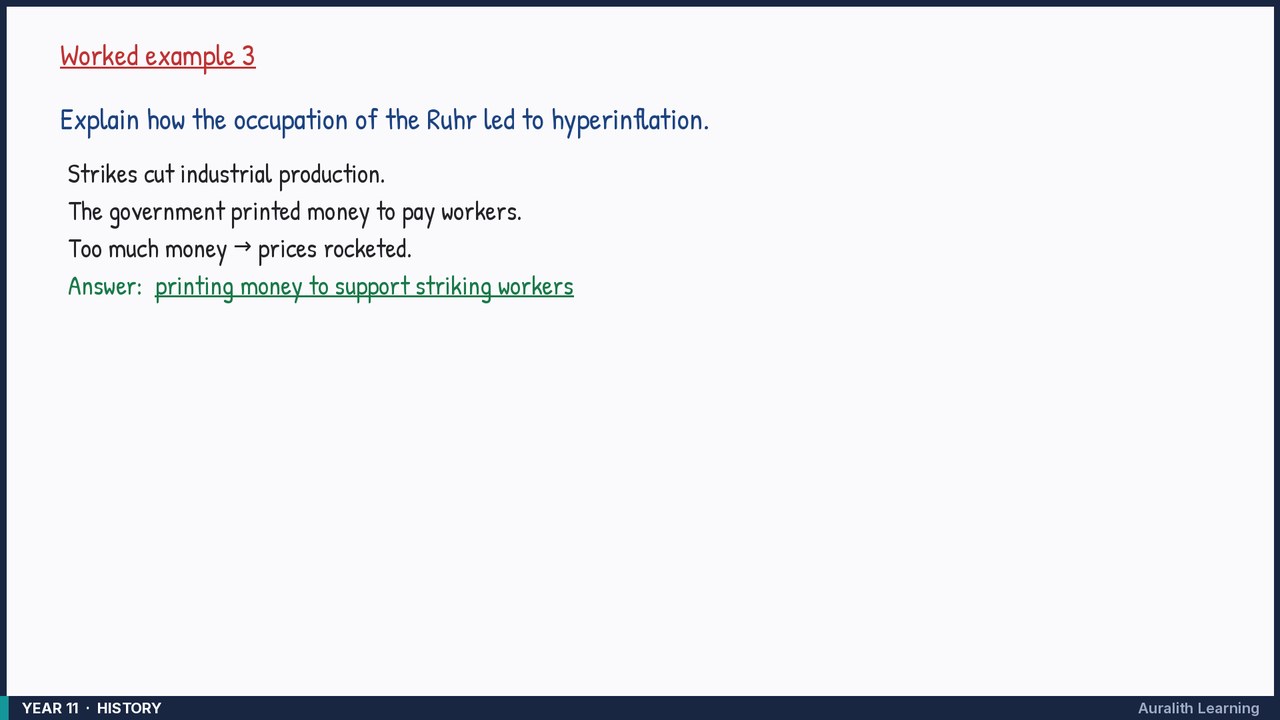
Explain how the occupation of the Ruhr led to hyperinflation.
- Step 1: Strikes cut industrial production.
- Step 2: The government printed money to pay workers.
- Step 3: Too much money → prices rocketed.
Answer: printing money to support striking workers