Year 11 (ages 15–16, Grade 10 in the US) · History · GCSE modern depth study · Lesson 6
Nazi control: terror, propaganda and opposition
How the Nazis controlled Germany through the police state — the SS, the Gestapo and concentration camps — through propaganda and censorship under Goebbels, their policies towards the churches, and the opposition that still existed.
Exam boards: this lesson matches the AQA and Pearson Edexcel GCSE history courses. Check which course your school follows.
8-minute video lesson
Teaching, worked examples and 20 practice questions solved step by step.
Watch free for a monthWhat your child will learn
- Describe the Nazi police state
- Explain how propaganda and censorship worked
- Explain Nazi policy towards the churches
- Describe opposition to the Nazis
The method
- Terror: SS, Gestapo, concentration camps, Nazi-controlled courts.
- Propaganda: rallies, radio, film, the 1936 Olympics.
- Censorship: books burned, newspapers controlled.
- Opposition existed but was risky and limited.
Key words: police state, Gestapo, propaganda, censorship, Concordat.
Worked examples
Worked examples from the lesson, with every step.
Question 1
What was the role of the Gestapo?
- Step 1: Secret police.
- Step 2: Informers, arrest without trial.
Answer: to find and arrest opponents
Question 2
How did the Nazis use radio as propaganda?
- Step 1: Cheap radios were sold.
- Step 2: Speeches and Nazi messages reached homes.
Answer: cheap radios spread Nazi messages
Question 3
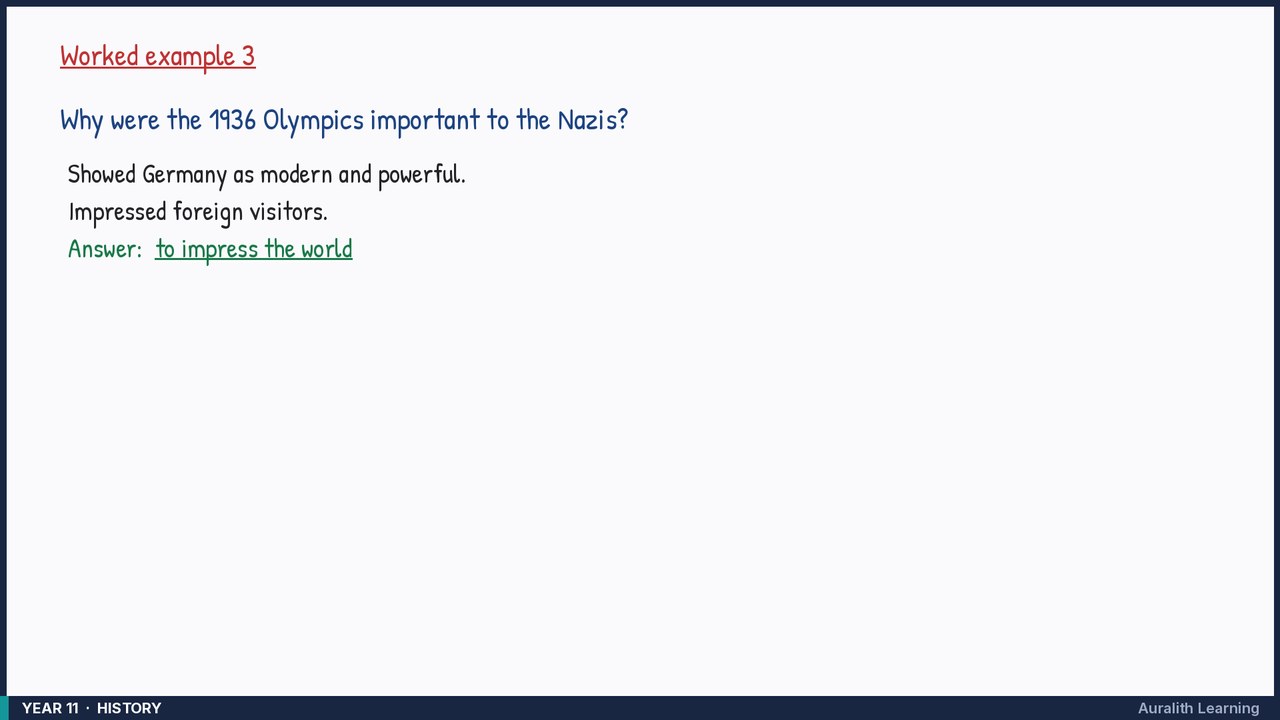
Why were the 1936 Olympics important to the Nazis?
- Step 1: Showed Germany as modern and powerful.
- Step 2: Impressed foreign visitors.
Answer: to impress the world