Year 11 (ages 15–16, Grade 10 in the US) · History · GCSE modern depth study · Lesson 5
Creating the Nazi dictatorship, 1933–1934
How Hitler turned his position as Chancellor into a dictatorship: the Reichstag Fire, the March 1933 election, the Enabling Act, the banning of trade unions and other parties, the Night of the Long Knives, and becoming Führer.
Exam boards: this lesson matches the AQA and Pearson Edexcel GCSE history courses. Check which course your school follows.
9-minute video lesson
Teaching, worked examples and 20 practice questions solved step by step.
Watch free for a monthWhat your child will learn
- Explain the significance of the Reichstag Fire
- Explain the importance of the Enabling Act
- Describe how opposition was removed
- Explain how Hitler became Führer
The method
- February 1933: Reichstag Fire — communists blamed.
- March 1933: Enabling Act — Hitler could make laws without the Reichstag.
- 1933: trade unions banned; Germany became a one-party state.
- 1934: Night of the Long Knives; Hindenburg died; Hitler became Führer.
Key words: Reichstag Fire, Enabling Act, one-party state, Night of the Long Knives, Führer.
Worked examples
Worked examples from the lesson, with every step.
Question 1
How did Hitler use the Reichstag Fire?
- Step 1: He blamed the communists.
- Step 2: An emergency decree let him arrest opponents.
Answer: to arrest communists and suspend rights
Question 2
Why was the Enabling Act so important?
- Step 1: Hitler could make laws without the Reichstag.
- Step 2: It made his dictatorship legal.
Answer: it gave Hitler power to rule without parliament
Question 3
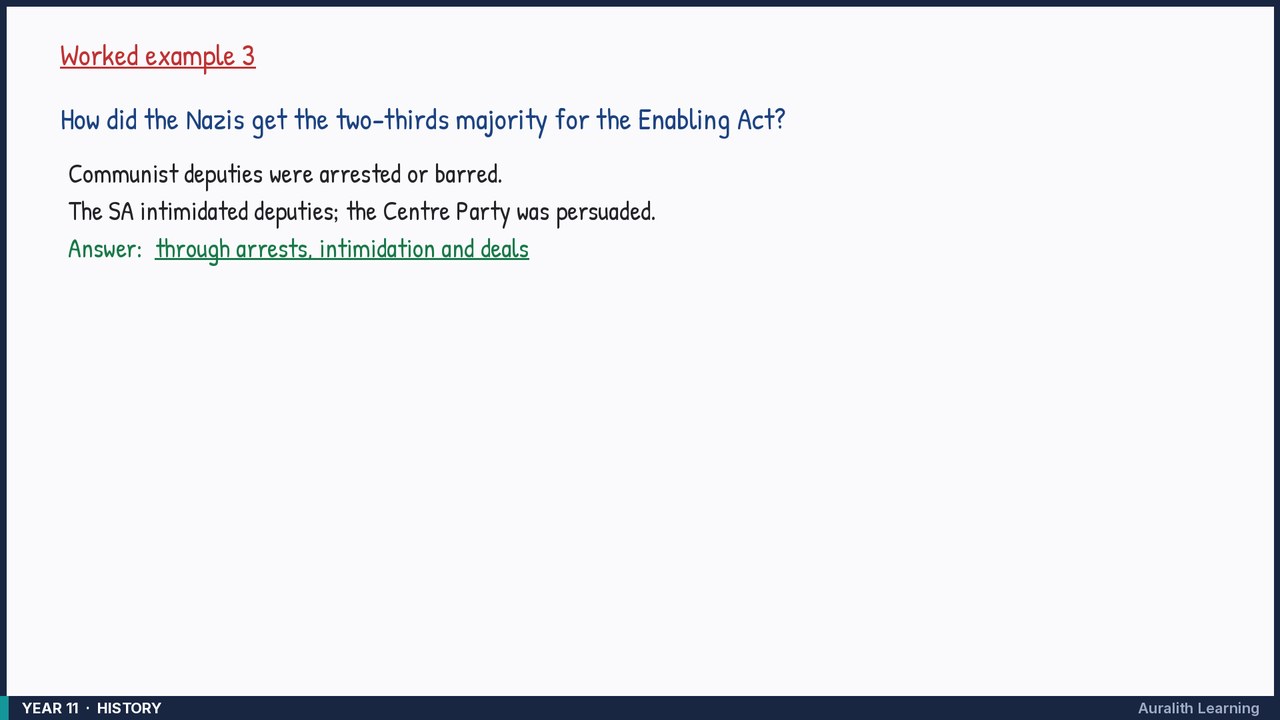
How did the Nazis get the two-thirds majority for the Enabling Act?
- Step 1: Communist deputies were arrested or barred.
- Step 2: The SA intimidated deputies; the Centre Party was persuaded.
Answer: through arrests, intimidation and deals