Year 10 (ages 14–15, Grade 9 in the US) · Computing · GCSE programming · Lesson 17
Sorting: merge sort and insertion sort
How merge sort splits a list into single items and merges them back in order, how insertion sort builds a sorted section one item at a time, and how the three sorting algorithms compare.
Exam boards: this lesson matches the AQA and Pearson Edexcel GCSE computing courses. Check which course your school follows.
8-minute video lesson
Teaching, worked examples and 20 practice questions solved step by step.
Watch free for a monthWhat your child will learn
- Describe merge sort
- Trace a merge
- Describe and trace insertion sort
- Compare bubble, merge and insertion sort
The method
- Merge sort: split until single items, then merge pairs in order.
- Merging: compare the fronts of two sorted lists; take the smaller.
- Insertion sort: take the next item; insert it into the sorted part.
- Compare: speed, memory, simplicity.
Key words: merge sort, insertion sort, divide and conquer, merge, efficiency.
Worked examples
Worked examples from the lesson, with every step.
Question 1
Split [8, 3, 5, 1] fully for merge sort.
- Step 1: [8, 3] [5, 1]
- Step 2: [8] [3] [5] [1]
Answer: [8] [3] [5] [1]
Question 2
Merge back: what are the two sorted pairs, then the final list?
- Step 1: [3, 8] and [1, 5]
- Step 2: [1, 3, 5, 8]
Answer: [1, 3, 5, 8]
Question 3
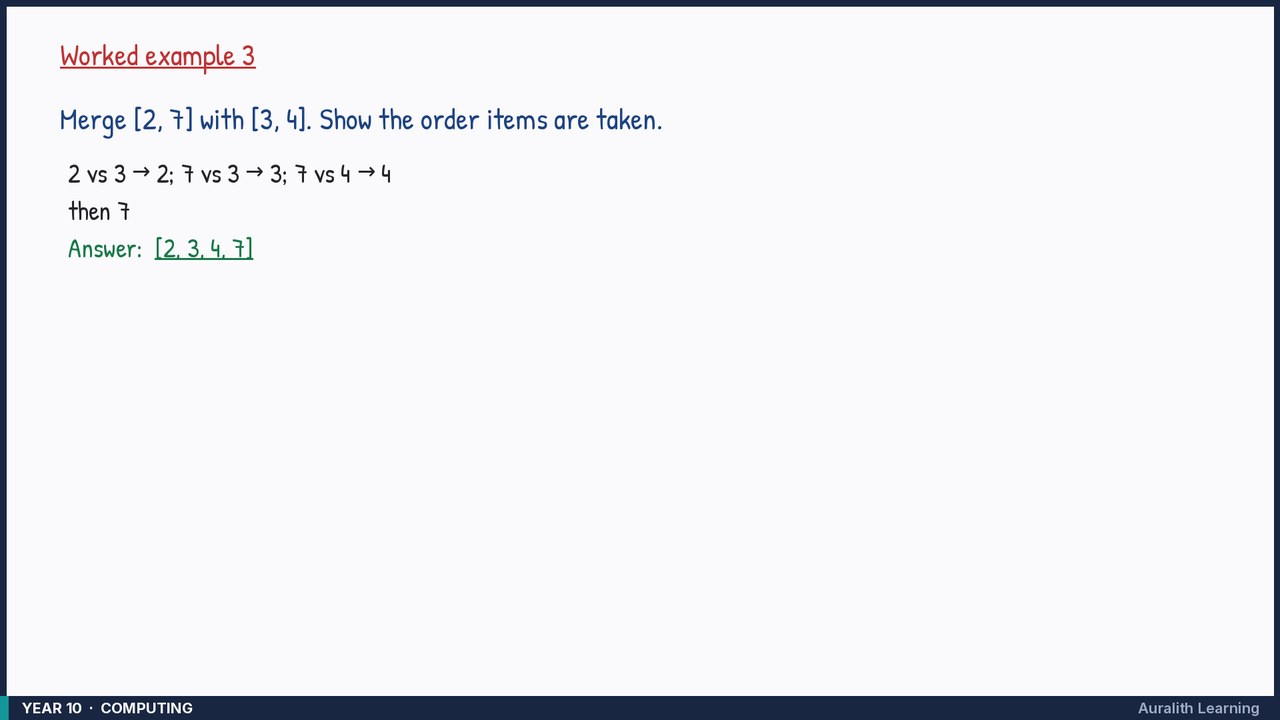
Merge [2, 7] with [3, 4]. Show the order items are taken.
- Step 1: 2 vs 3 → 2; 7 vs 3 → 3; 7 vs 4 → 4
- Step 2: then 7
Answer: [2, 3, 4, 7]