Year 10 (ages 14–15, Grade 9 in the US) · Computing · GCSE programming · Lesson 13
Errors and testing
The three types of error (syntax, logic and runtime), how to find and fix them, iterative and final testing, and choosing normal, boundary and erroneous test data for a test plan.
Exam boards: this lesson matches the AQA and Pearson Edexcel GCSE computing courses. Check which course your school follows.
8-minute video lesson
Teaching, worked examples and 20 practice questions solved step by step.
Watch free for a monthWhat your child will learn
- Identify syntax, logic and runtime errors
- Explain iterative and final testing
- Choose normal, boundary and erroneous test data
- Complete a test plan
The method
- Syntax: breaks the language rules — won't run.
- Logic: runs but gives the wrong result.
- Runtime: crashes while running.
- Test data: normal, boundary (edges), erroneous (invalid).
Key words: syntax error, logic error, runtime error, boundary data, test plan.
Worked examples
Worked examples from the lesson, with every step.
Question 1
Which error type? c:print("Hi"
- Step 1: Missing closing bracket.
- Step 2: Breaks language rules → syntax.
Answer: syntax error
Question 2
Which error type? c:average = total / count # count is 0
- Step 1: Division by zero.
- Step 2: Crashes while running → runtime.
Answer: runtime error
Question 3
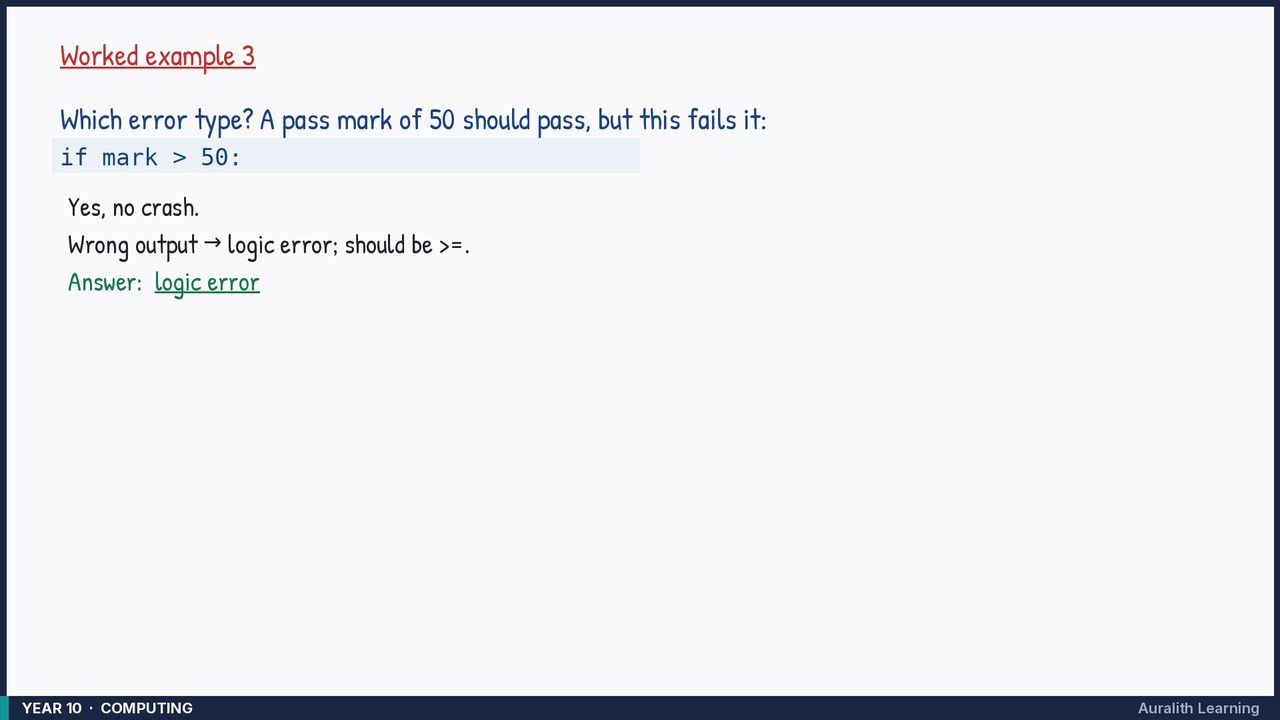
Which error type? A pass mark of 50 should pass, but this fails it: c:if mark > 50:
- Step 1: Yes, no crash.
- Step 2: Wrong output → logic error; should be >=.
Answer: logic error