Year 10 (ages 14–15, Grade 9 in the US) · Computing · GCSE programming · Lesson 18
Computational thinking, pseudocode and flowcharts
The three parts of computational thinking — abstraction, decomposition and algorithmic thinking — and how to design algorithms with pseudocode and flowcharts, including the standard flowchart symbols and inputs, processes and outputs.
Exam boards: this lesson matches the AQA and Pearson Edexcel GCSE computing courses. Check which course your school follows.
8-minute video lesson
Teaching, worked examples and 20 practice questions solved step by step.
Watch free for a monthWhat your child will learn
- Define abstraction, decomposition and algorithmic thinking
- Identify inputs, processes and outputs
- Use the flowchart symbols
- Write simple pseudocode
The method
- Abstraction: remove unnecessary detail.
- Decomposition: break into smaller parts.
- Algorithmic thinking: work out the steps in order.
- Design with pseudocode or a flowchart before coding.
Key words: abstraction, decomposition, algorithmic thinking, pseudocode, flowchart.
Worked examples
Worked examples from the lesson, with every step.
Question 1
Which part of computational thinking? A map of a bus route shows stops but not buildings.
- Step 1: Unnecessary detail (buildings).
- Step 2: Abstraction.
Answer: abstraction
Question 2
Decompose a ‘quiz game’ program.
- Step 1: Ask questions; check answers; keep score.
- Step 2: Show final score; store high scores.
Answer: questions, checking, scoring, results, high scores
Question 3
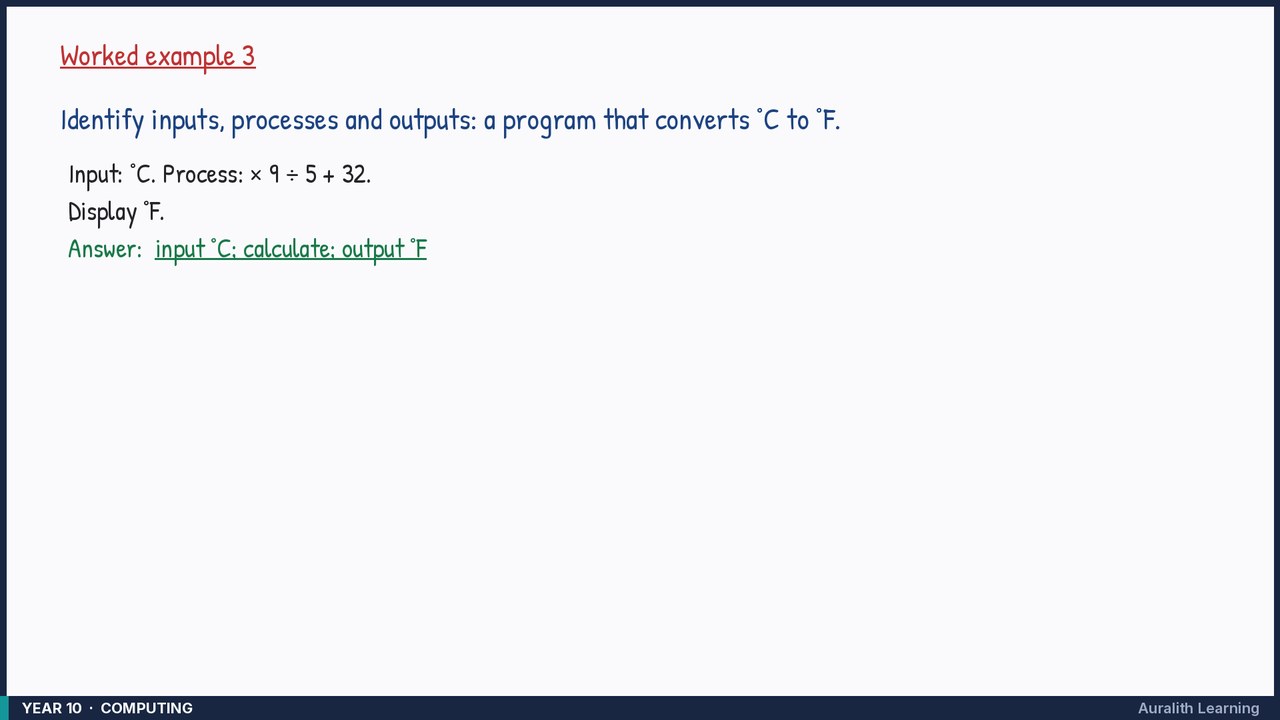
Identify inputs, processes and outputs: a program that converts °C to °F.
- Step 1: Input: °C. Process: × 9 ÷ 5 + 32.
- Step 2: Display °F.
Answer: input °C; calculate; output °F