Year 10 (ages 14–15, Grade 9 in the US) · History · GCSE period study · Lesson 2
Truman Doctrine, Marshall Plan and the Berlin Crisis
The US policy of containment through the Truman Doctrine and Marshall Plan (1947), the Soviet response with Cominform and Comecon, the Berlin Blockade and Airlift (1948–49), and the creation of two German states, NATO and the Warsaw Pact.
Exam boards: this lesson matches the AQA and Pearson Edexcel GCSE history courses. Check which course your school follows.
9-minute video lesson
Teaching, worked examples and 20 practice questions solved step by step.
Watch free for a monthWhat your child will learn
- Explain the Truman Doctrine and Marshall Plan
- Describe the Soviet response
- Explain the Berlin Blockade and Airlift
- Explain the consequences, including NATO
The method
- Truman Doctrine (March 1947): contain communism.
- Marshall Plan (June 1947): economic aid to Europe.
- Soviet reply: Cominform 1947, Comecon 1949.
- Berlin 1948–49 → FRG and GDR, NATO 1949, Warsaw Pact 1955.
Key words: containment, Marshall Aid, Cominform, Berlin Airlift, NATO.
Worked examples
Worked examples from the lesson, with every step.
Question 1
Explain the purpose of the Marshall Plan.
- Step 1: Economic help to rebuild Europe.
- Step 2: Strong economies resist communism.
Answer: to rebuild Europe and contain communism
Question 2
Why did Stalin blockade Berlin in 1948?
- Step 1: New Western currency in West Germany.
- Step 2: Force the West out of Berlin.
Answer: to force the West to give up West Berlin
Question 3
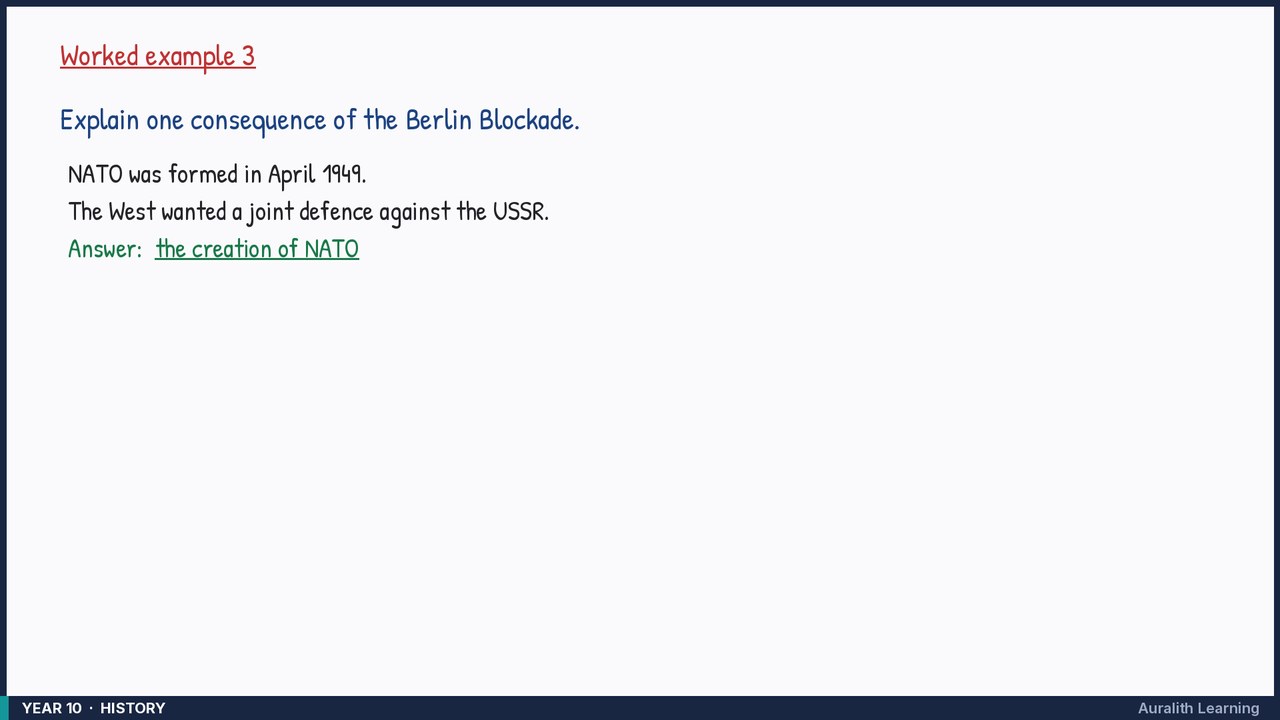
Explain one consequence of the Berlin Blockade.
- Step 1: NATO was formed in April 1949.
- Step 2: The West wanted a joint defence against the USSR.
Answer: the creation of NATO