Year 10 (ages 14–15, Grade 9 in the US) · History · GCSE period study · Lesson 3
The Hungarian Uprising, 1956
Why Hungarians rose against Soviet control in 1956, Imre Nagy's reforms, Khrushchev's decision to invade, the crushing of the uprising, and the international reaction and consequences.
Exam boards: this lesson matches the AQA and Pearson Edexcel GCSE history courses. Check which course your school follows.
9-minute video lesson
Teaching, worked examples and 20 practice questions solved step by step.
Watch free for a monthWhat your child will learn
- Explain the causes of the uprising
- Describe Nagy's reforms
- Explain why Khrushchev invaded
- Explain the international reaction
The method
- Causes: Soviet control, poverty, de-Stalinisation hopes.
- Nagy's reforms went too far for Moscow — leaving the Warsaw Pact.
- Soviet tanks crushed the uprising in November 1956.
- The West protested but did not intervene.
Key words: de-Stalinisation, Nagy, Khrushchev, Warsaw Pact, uprising.
Worked examples
Worked examples from the lesson, with every step.
Question 1
Explain one cause of the Hungarian Uprising.
- Step 1: Khrushchev's criticism of Stalin.
- Step 2: Hungarians hoped for more freedom.
Answer: de-Stalinisation raised hopes of greater freedom
Question 2
Why did Khrushchev send tanks into Hungary?
- Step 1: Nagy planned to leave the Warsaw Pact.
- Step 2: Other satellites might follow.
Answer: to stop Hungary leaving the Warsaw Pact and others copying
Question 3
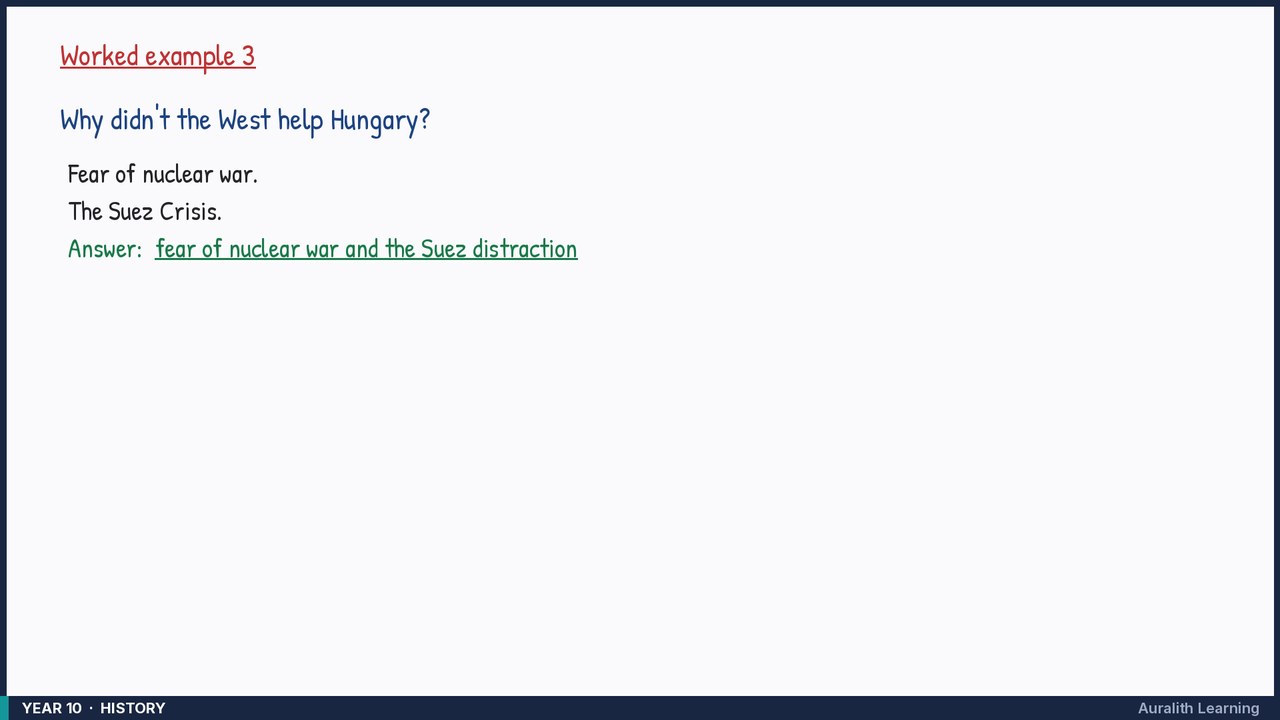
Why didn't the West help Hungary?
- Step 1: Fear of nuclear war.
- Step 2: The Suez Crisis.
Answer: fear of nuclear war and the Suez distraction