Year 10 (ages 14–15, Grade 9 in the US) · History · GCSE period study · Lesson 8
Afghanistan to the end of the Cold War, 1979–91
The Soviet invasion of Afghanistan (1979), the Carter Doctrine and Olympic boycotts, Reagan's 'Second Cold War' and SDI, Gorbachev's reforms, the INF Treaty (1987), the fall of the Berlin Wall (1989) and the collapse of the USSR (1991).
Exam boards: this lesson matches the Pearson Edexcel GCSE history courses. Check which course your school follows.
9-minute video lesson
Teaching, worked examples and 20 practice questions solved step by step.
Watch free for a monthWhat your child will learn
- Explain the impact of the invasion of Afghanistan
- Describe Reagan's policies
- Explain Gorbachev's new thinking
- Explain how the Cold War ended
The method
- 1979: Soviet invasion of Afghanistan ends détente.
- Reagan: arms build-up and SDI.
- Gorbachev from 1985: glasnost, perestroika, arms deals.
- 1989 Wall falls; 1991 Warsaw Pact ends and USSR collapses.
Key words: Carter Doctrine, SDI, glasnost, perestroika, INF Treaty.
Worked examples
Worked examples from the lesson, with every step.
Question 1
Explain one consequence of the Soviet invasion of Afghanistan.
- Step 1: The USA boycotted the 1980 Moscow Olympics.
- Step 2: Détente ended; relations worsened.
Answer: the end of détente, shown by the Olympic boycott
Question 2
What was SDI?
- Step 1: Strategic Defense Initiative, 1983.
- Step 2: Space-based defence against missiles.
Answer: Reagan's planned space-based missile defence, ‘Star Wars’
Question 3
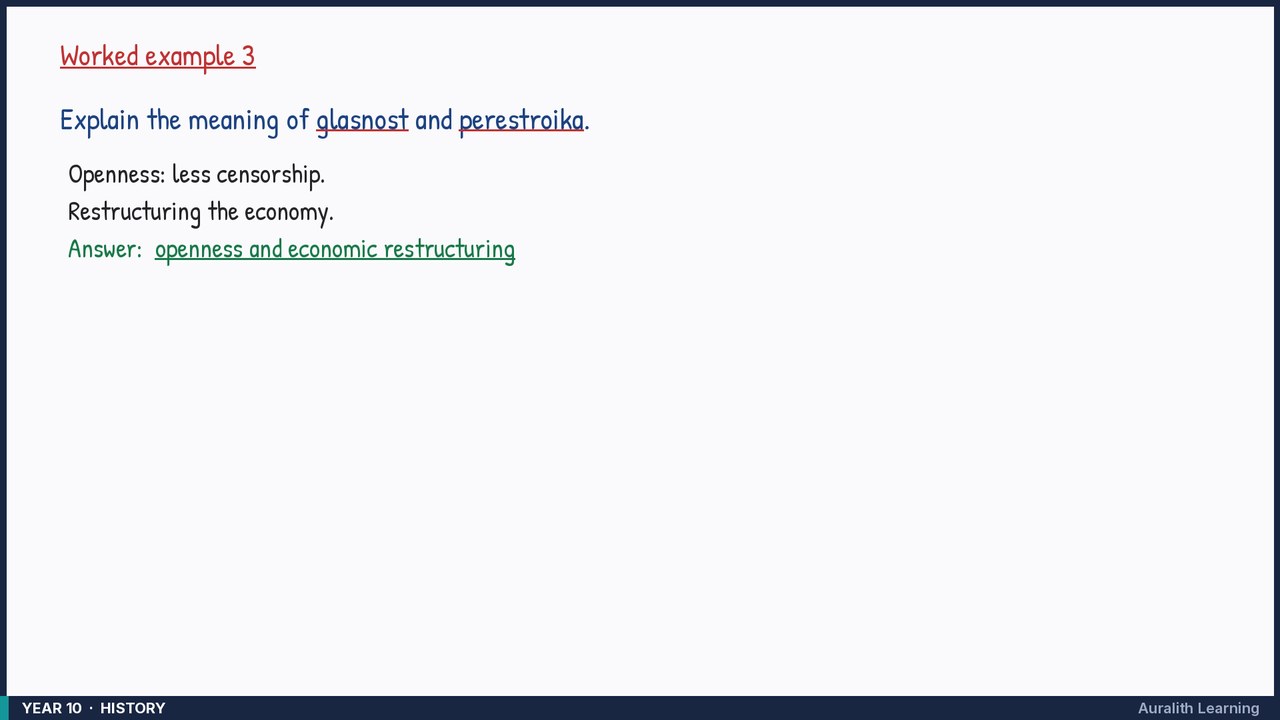
Explain the meaning of glasnost and perestroika.
- Step 1: Openness: less censorship.
- Step 2: Restructuring the economy.
Answer: openness and economic restructuring