Year 10 (ages 14–15, Grade 9 in the US) · History · GCSE period study · Lesson 6
Czechoslovakia and the Prague Spring, 1968
Dubček's reforms of 'socialism with a human face' in 1968, why the Warsaw Pact invaded in August 1968, the Brezhnev Doctrine, and the international reaction.
Exam boards: this lesson matches the AQA and Pearson Edexcel GCSE history courses. Check which course your school follows.
9-minute video lesson
Teaching, worked examples and 20 practice questions solved step by step.
Watch free for a monthWhat your child will learn
- Describe Dubček's reforms
- Explain why the USSR invaded
- Explain the Brezhnev Doctrine
- Compare with Hungary 1956
The method
- Background: discontent with Soviet control.
- Dubček's reforms (from January 1968).
- Invasion: 20–21 August 1968.
- Brezhnev Doctrine and Western reaction.
Key words: Prague Spring, Dubček, socialism with a human face, Brezhnev Doctrine, Warsaw Pact.
Worked examples
Worked examples from the lesson, with every step.
Question 1
Describe two of Dubček's reforms.
- Step 1: Less censorship.
- Step 2: More trade with the West.
Answer: less censorship; more trade with the West
Question 2
Explain why Brezhnev invaded Czechoslovakia.
- Step 1: Reforms might spread.
- Step 2: Weaken Soviet control of the bloc.
Answer: to stop reforms spreading and keep control
Question 3
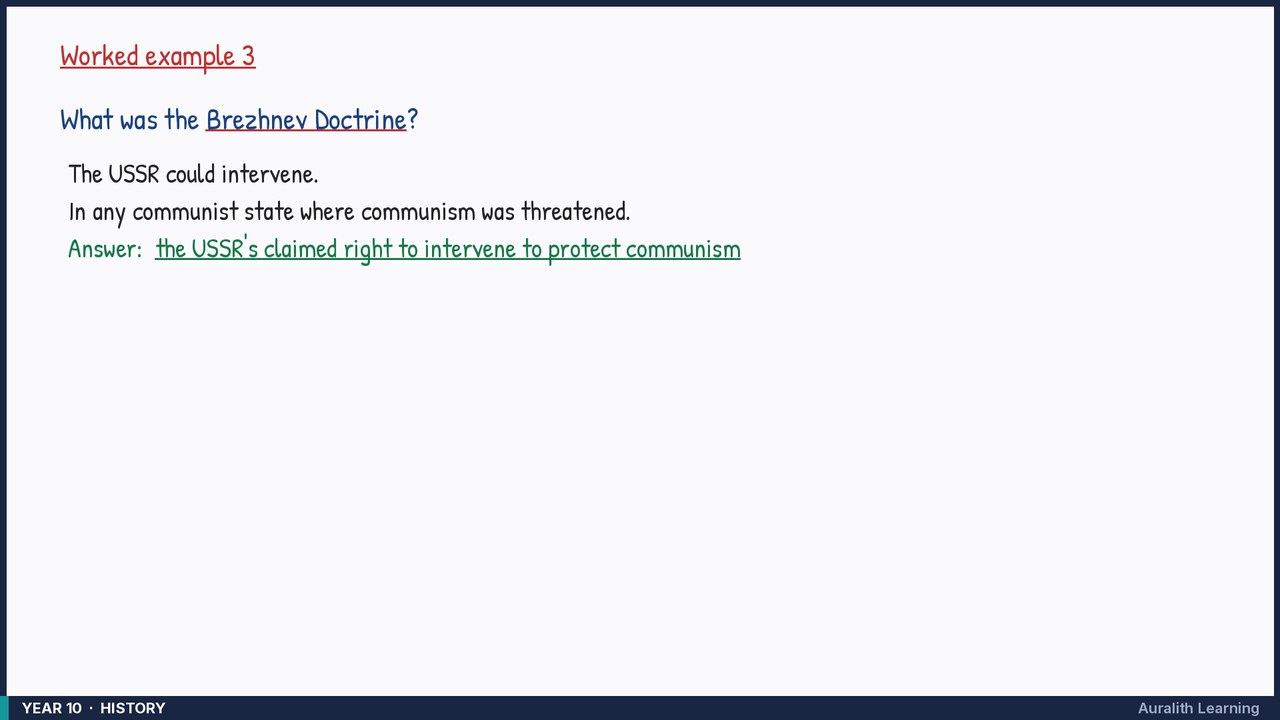
What was the Brezhnev Doctrine?
- Step 1: The USSR could intervene.
- Step 2: In any communist state where communism was threatened.
Answer: the USSR's claimed right to intervene to protect communism