Year 10 (ages 14–15, Grade 9 in the US) · History · GCSE period study · Lesson 5
The Cuban Missile Crisis, 1962
Castro's revolution, the failed Bay of Pigs invasion, Soviet missiles on Cuba, the thirteen days of October 1962, how the crisis was resolved, and its consequences: the hotline and the Limited Test Ban Treaty.
Exam boards: this lesson matches the AQA and Pearson Edexcel GCSE history courses. Check which course your school follows.
9-minute video lesson
Teaching, worked examples and 20 practice questions solved step by step.
Watch free for a monthWhat your child will learn
- Explain why Cuba became a Cold War issue
- Describe the Bay of Pigs invasion
- Narrate the thirteen days
- Explain the consequences of the crisis
The method
- 1959: Castro takes power; Cuba turns to the USSR.
- 1961: Bay of Pigs failure.
- October 1962: missiles discovered; US blockade; deal reached.
- Consequences: hotline 1963, Test Ban Treaty 1963, Outer Space Treaty 1967, NPT 1968.
Key words: Castro, Bay of Pigs, blockade, hotline, Test Ban Treaty.
Worked examples
Worked examples from the lesson, with every step.
Question 1
Explain why the Bay of Pigs increased tension.
- Step 1: US-backed exiles invaded Cuba, April 1961.
- Step 2: Castro turned to the USSR for protection.
Answer: it pushed Castro towards the USSR
Question 2
Give two reasons Khrushchev placed missiles on Cuba.
- Step 1: Protect Cuba from invasion.
- Step 2: Close the missile gap.
Answer: protect Cuba; close the missile gap
Question 3
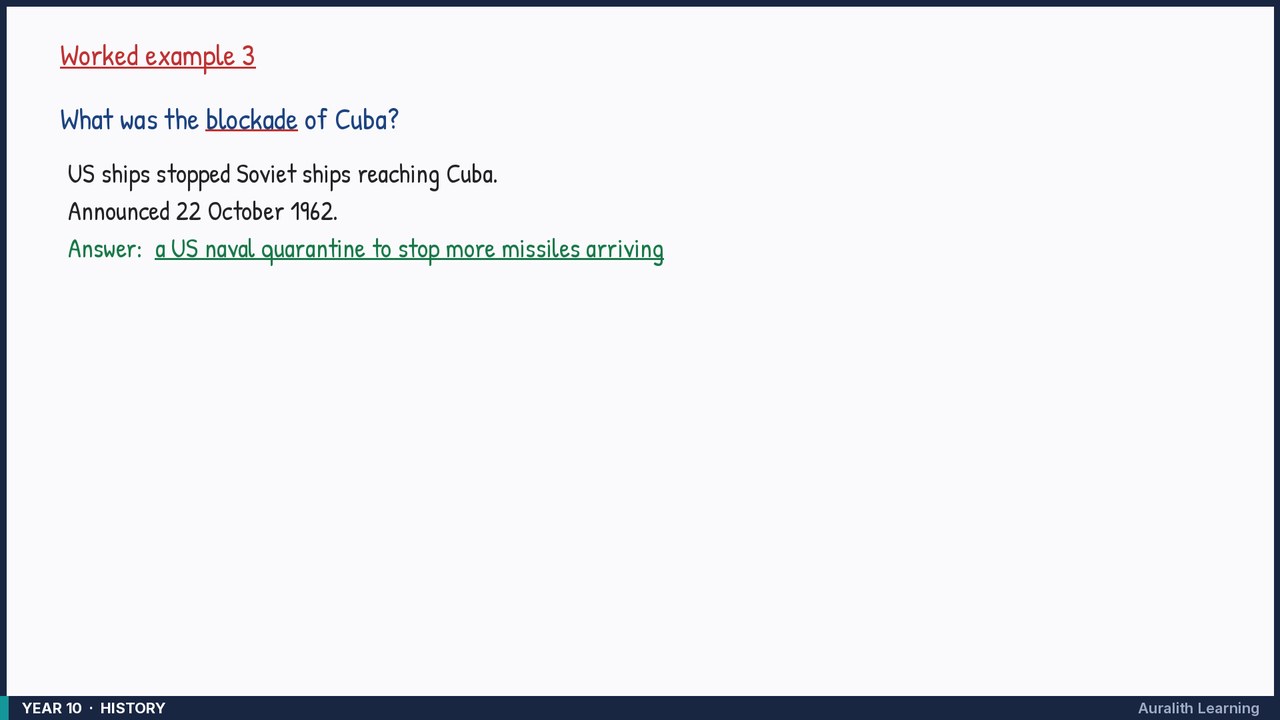
What was the blockade of Cuba?
- Step 1: US ships stopped Soviet ships reaching Cuba.
- Step 2: Announced 22 October 1962.
Answer: a US naval quarantine to stop more missiles arriving