Year 10 (ages 14–15, Grade 9 in the US) · History · GCSE period study · Lesson 7
Détente in the 1970s
Why the superpowers eased tension in the 1970s, and the key agreements: SALT 1 (1972), the Apollo–Soyuz mission (1975), the Helsinki Agreements (1975) and SALT 2 (1979), plus the limits of détente.
Exam boards: this lesson matches the AQA and Pearson Edexcel GCSE history courses. Check which course your school follows.
8-minute video lesson
Teaching, worked examples and 20 practice questions solved step by step.
Watch free for a monthWhat your child will learn
- Explain what détente means
- Explain why both sides wanted it
- Describe the key agreements
- Explain the limits of détente
The method
- Détente: a relaxing of tension.
- Reasons: cost of the arms race, fear of war, other problems.
- Agreements: SALT 1 1972, Apollo–Soyuz 1975, Helsinki 1975, SALT 2 1979.
- Limits: arms still built; SALT 2 never ratified.
Key words: détente, SALT 1, Helsinki Agreements, Apollo–Soyuz, SALT 2.
Worked examples
Worked examples from the lesson, with every step.
Question 1
What does détente mean?
- Step 1: A relaxing of tension.
- Step 2: About 1969–79.
Answer: a period of eased tension in the 1970s
Question 2
Give two reasons the USA wanted détente.
- Step 1: The cost of the Vietnam War.
- Step 2: Economic problems at home.
Answer: Vietnam costs; economic problems
Question 3
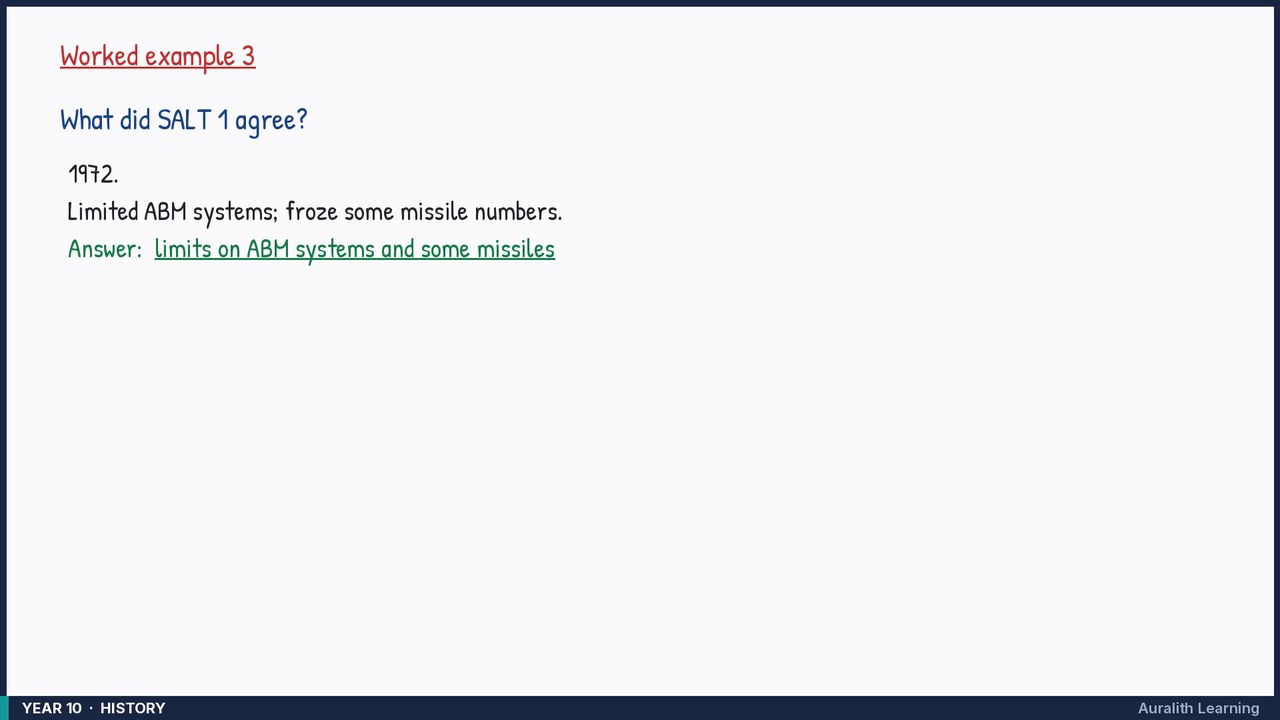
What did SALT 1 agree?
- Step 1: 1972.
- Step 2: Limited ABM systems; froze some missile numbers.
Answer: limits on ABM systems and some missiles