Year 10 (ages 14–15, Grade 9 in the US) · History · GCSE period study · Lesson 1
Origins of the Cold War, 1941–47
Why the wartime Grand Alliance broke down: different ideologies, the Tehran, Yalta and Potsdam conferences, the atomic bomb, the Long and Novikov telegrams, and Soviet control of Eastern Europe.
Exam boards: this lesson matches the AQA and Pearson Edexcel GCSE history courses. Check which course your school follows.
9-minute video lesson
Teaching, worked examples and 20 practice questions solved step by step.
Watch free for a monthWhat your child will learn
- Explain the ideological differences
- Describe the wartime conferences
- Explain the impact of the atomic bomb and telegrams
- Explain how Soviet control of Eastern Europe grew
The method
- Ideology: capitalism vs communism.
- Conferences: Tehran 1943, Yalta Feb 1945, Potsdam July 1945.
- Growing distrust: atomic bomb, telegrams, Iron Curtain speech.
- Consequence: Soviet satellite states in Eastern Europe.
Key words: capitalism, communism, Grand Alliance, satellite state, Iron Curtain.
Worked examples
Worked examples from the lesson, with every step.
Question 1
Describe one difference between capitalism and communism.
- Step 1: Private ownership of businesses.
- Step 2: State control of the economy.
Answer: private ownership versus state control
Question 2
What was agreed at Yalta about Germany?
- Step 1: Germany would be divided.
- Step 2: Four zones: USA, USSR, Britain, France.
Answer: Germany would be divided into four zones
Question 3
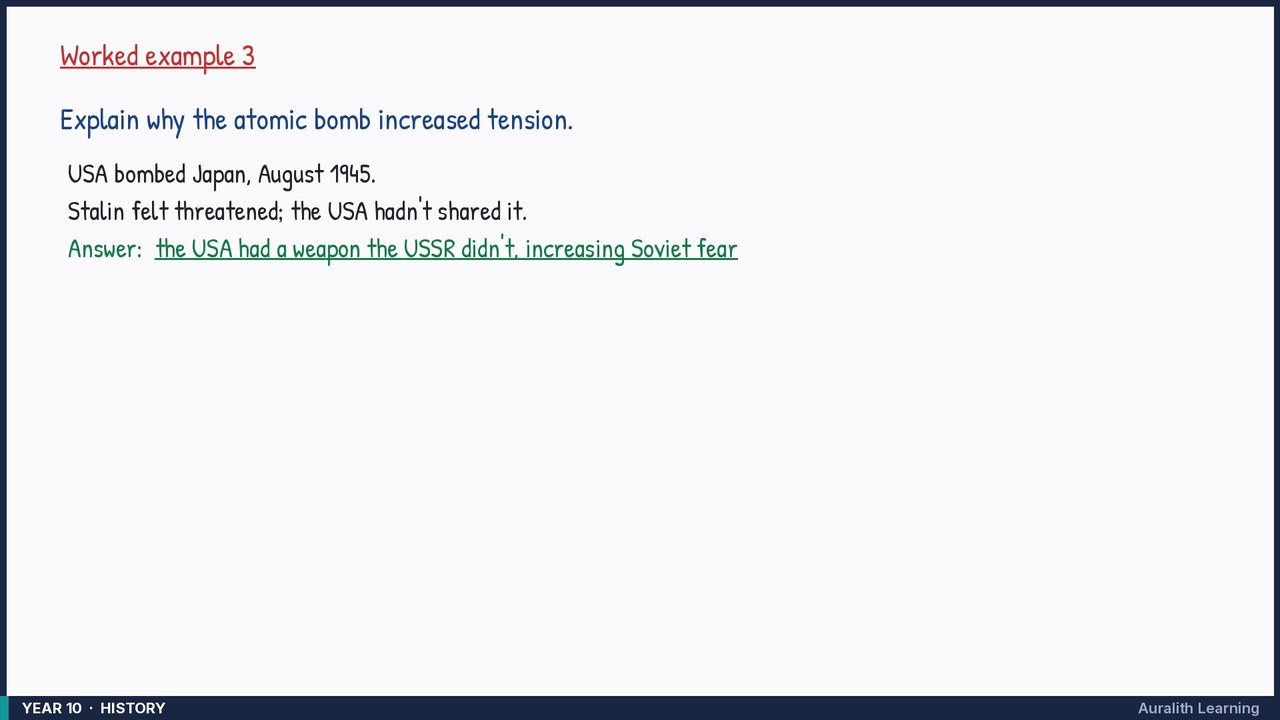
Explain why the atomic bomb increased tension.
- Step 1: USA bombed Japan, August 1945.
- Step 2: Stalin felt threatened; the USA hadn't shared it.
Answer: the USA had a weapon the USSR didn't, increasing Soviet fear