Year 10 (ages 14–15, Grade 9 in the US) · Languages · GCSE themes, part 1 · Lesson 15
Writing longer answers and translating into French
Exam technique for GCSE French writing: covering every bullet point, using three time frames, opinions with reasons, connectives and a range of structures, plus a method for translating sentences into French accurately.
Exam boards: this lesson matches the AQA and Pearson Edexcel GCSE languages courses. Check which course your school follows.
8-minute video lesson
Teaching, worked examples and 20 practice questions solved step by step.
Watch free for a monthWhat your child will learn
- Plan a longer written answer
- Use past, present and future time frames
- Add opinions, reasons and complex structures
- Translate sentences into French accurately
The method
- Cover every bullet point — tick each one.
- Show three time frames: past, present, future.
- Add opinions + reasons; link with connectives.
- Translate: find the verb and tense first, then check agreement and accents.
Key words: time frame, connective, opinion, translation, accuracy.
Worked examples
Worked examples from the lesson, with every step.
Question 1
Translate: Last year, I went to France with my family.
- Step 1: aller, perfect with être: «je suis allé(e)»
- Step 2: «en France avec ma famille»
Answer: «L'année dernière, je suis allé(e) en France avec ma famille.»
Question 2
Translate: Usually, I play tennis but I don't like swimming.
- Step 1: «D'habitude, je joue au tennis»
- Step 2: «mais je n'aime pas nager»
Answer: «D'habitude, je joue au tennis mais je n'aime pas nager.»
Question 3
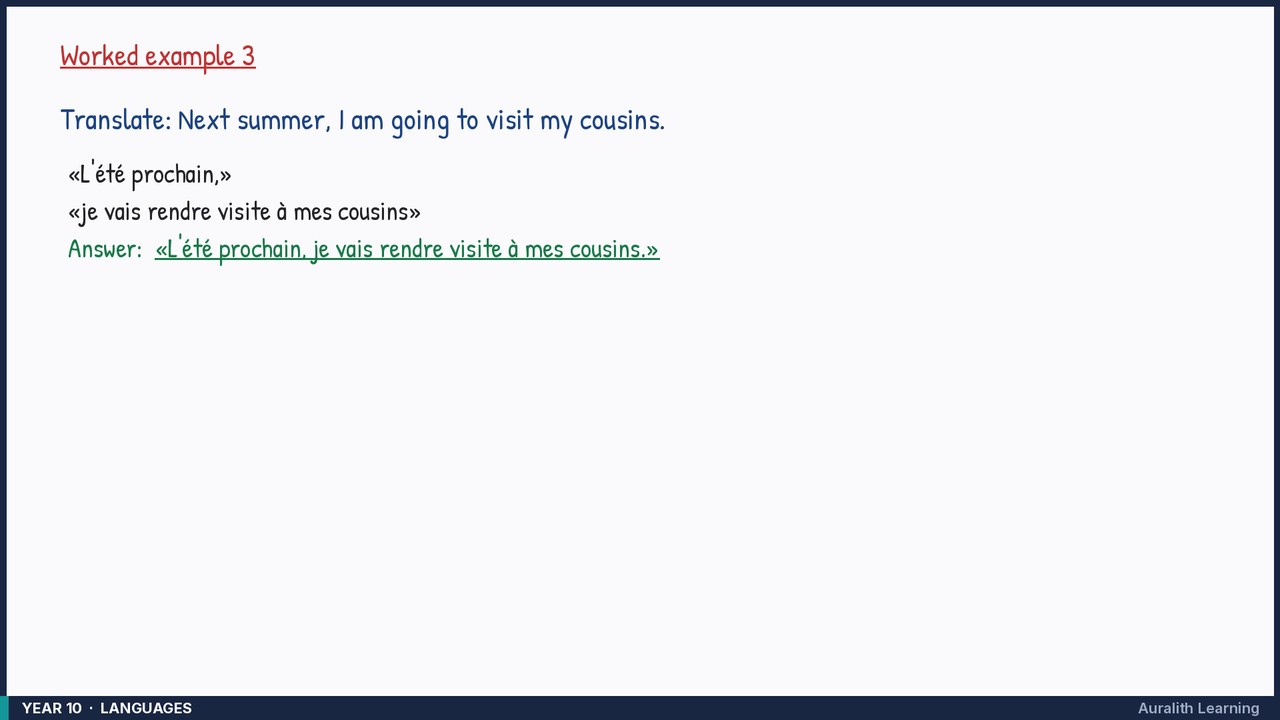
Translate: Next summer, I am going to visit my cousins.
- Step 1: «L'été prochain,»
- Step 2: «je vais rendre visite à mes cousins»
Answer: «L'été prochain, je vais rendre visite à mes cousins.»