Year 10 (ages 14–15, Grade 9 in the US) · Languages · GCSE themes, part 1 · Lesson 10
Music, film and TV: the perfect tense with avoir
Talking about music, films and TV in French, forming the perfect tense with avoir and a past participle (regular and irregular), time phrases for the past, and opinions in the past with c'était.
Exam boards: this lesson matches the AQA and Pearson Edexcel GCSE languages courses. Check which course your school follows.
8-minute video lesson
Teaching, worked examples and 20 practice questions solved step by step.
Watch free for a monthWhat your child will learn
- Form the perfect tense with avoir
- Use irregular past participles
- Use past time phrases
- Give opinions in the past with c'était
The method
- avoir (present) + past participle: «j'ai regardé».
- -er → -é; -ir → -i; -re → -u.
- Irregulars: «vu», «lu», «fait», «bu», «pris», «eu».
- Opinion: «C'était génial / nul.»
Key words: perfect tense, past participle, avoir, irregular, c'était.
Worked examples
Worked examples from the lesson, with every step.
Question 1
Translate: I listened to music.
- Step 1: «écouter» → «écouté»
- Step 2: «J'ai écouté de la musique.»
Answer: «J'ai écouté de la musique.»
Question 2
Translate: Last weekend, I saw a comedy.
- Step 1: «Le week-end dernier,»
- Step 2: «voir» → «vu»: «j'ai vu une comédie»
Answer: «Le week-end dernier, j'ai vu une comédie.»
Question 3
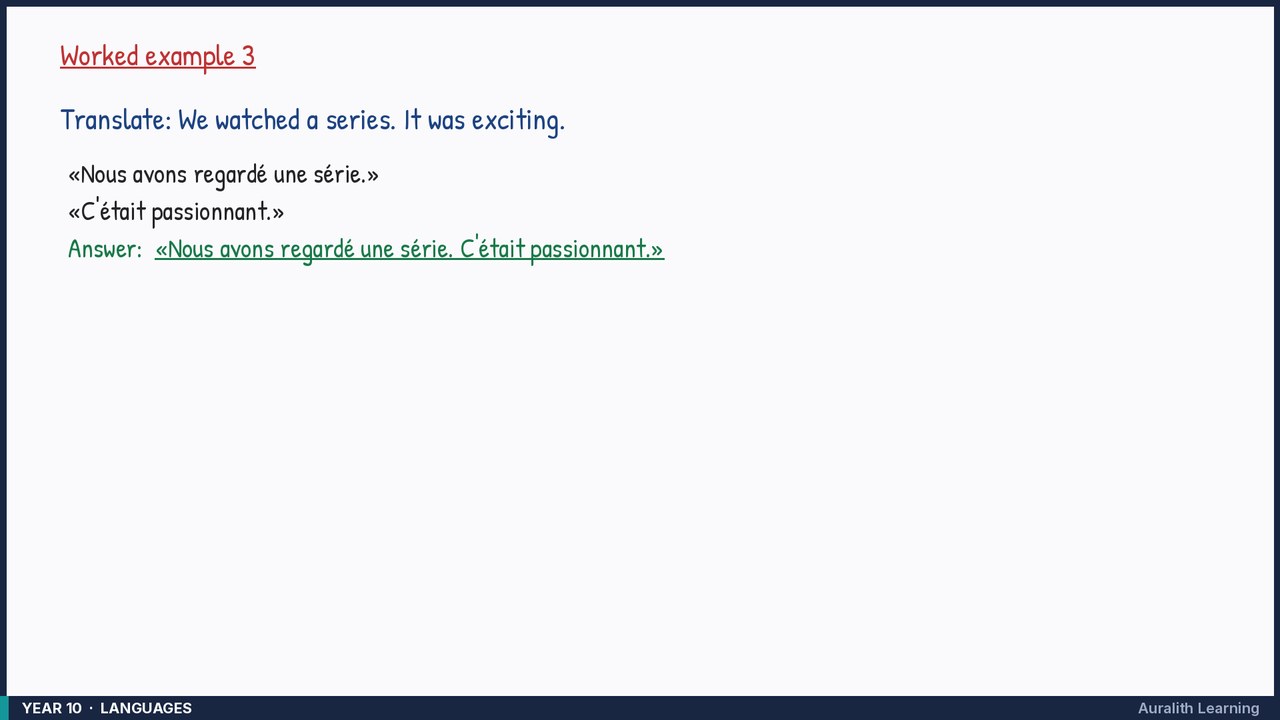
Translate: We watched a series. It was exciting.
- Step 1: «Nous avons regardé une série.»
- Step 2: «C'était passionnant.»
Answer: «Nous avons regardé une série. C'était passionnant.»